Social media content marketing is no longer a side function of marketing. It does not sit next to a brand — it is the brand in everyday public view. For many people, social platforms are the first place where a company becomes real, and sometimes the only place where it is judged.
The challenge is that social platforms do not reward effort by default. Posting often does not guarantee attention. High production value does not guarantee trust. Social content does not behave like advertising or public relations. It follows a different logic, one that cannot be rushed or forced.
This guide is not about formulas or growth tricks. It is about how social media content actually works when brands stop chasing noise and start thinking about presence, continuity, and credibility.
What Is Social Media Content Marketing
Social media marketing is not defined by posts or metrics. It is defined by behavior.
At its core, it is the way a brand shows up in public spaces where people are watching all the time. Sometimes actively, sometimes in passing. The content may be useful, explanatory, calm, or even quiet — but over time it forms a pattern. And that pattern becomes expectation.
Unlike campaigns, social content does not end. It accumulates, eventually functioning as a living social media portfolio of your brand’s history and values. Each post adds a layer to how a brand is understood, or erodes that understanding if it breaks consistency.
Strong social content rarely looks like marketing. It looks like a presence that feels stable. People recognize it without effort. They know what tone to expect. That familiarity is not accidental — it is the result of restraint and repetition.
Benefits of Social Media Content Marketing
The value of social media content is often invisible until it is gone. When brands stop showing up, the absence is felt faster than most teams expect.
Social platforms have become trust filters. According to DataReportal, users in 2025 spent more than two hours per day on social media on average. During that time, opinions form quietly — long before a purchase or inquiry happens.
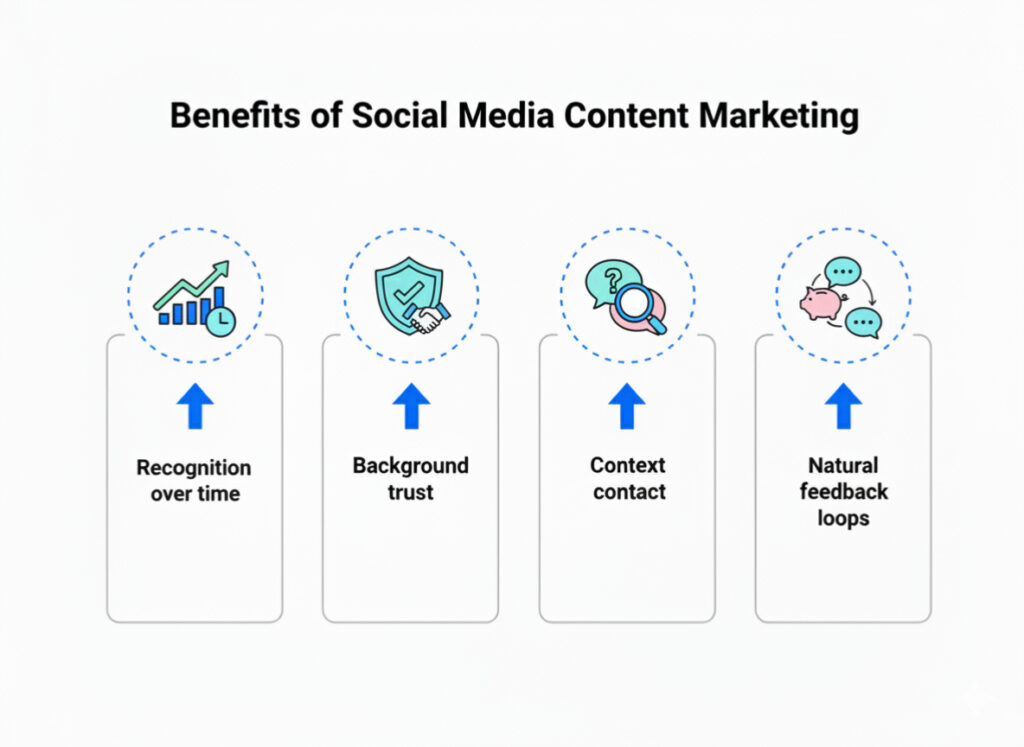
Effective social media content marketing creates several long-term advantages:
- Recognition over time. Consistent presence makes a brand identifiable even without logos or explanations.
- Background trust. Familiarity lowers skepticism when people encounter the brand elsewhere.
- Context before contact. By the time someone visits a website or reaches out, they already understand tone and values.
- Natural feedback loops. Comments and reactions often reveal more than structured research.
- Less pressure on sales. Content absorbs part of the explanation and education work.
These benefits do not arrive quickly. They compound. And they disappear just as slowly when consistency breaks.
Types of Social Media Content Marketing
Not all social content does the same job, even when it looks similar on the surface. One of the most common mistakes brands make is using one type of content to solve every problem.
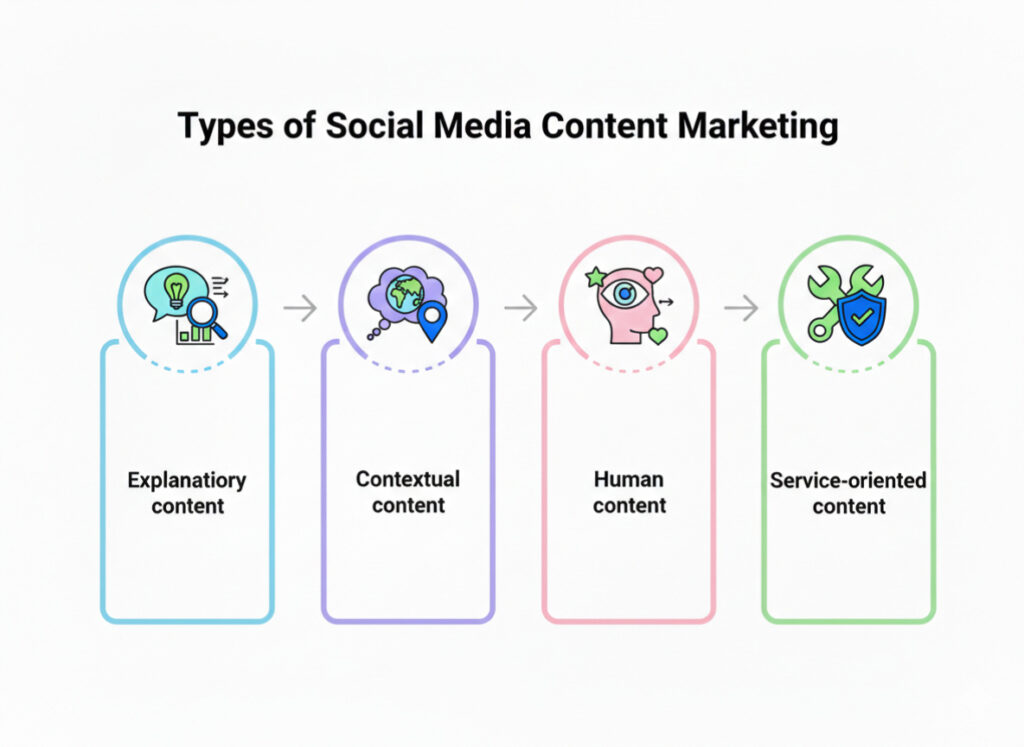
In practice, social content usually falls into a few functional categories:
- Explanatory content. Helps people understand a product, service, or topic without urgency;
- Contextual content. Responds to changes, industry shifts, or recurring audience questions;
- Human content. Shows people, processes, and decisions behind the brand;
- Perspective-driven content. Shares opinions or viewpoints rather than neutral information;
- Service-oriented content. Updates, reminders, and responses that reduce friction, especially when brands use tools like WhatsApp automation software to manage timely, personalized communication at scale.
Balance matters more than format. A well-produced video fails if it tries to solve the wrong problem.
Content Pillars Social Media Marketing
Content pillars are not themes chosen for convenience. They are commitments.
Each pillar represents something a brand is willing to talk about repeatedly and stand behind publicly. Good pillars come from reality — from what the organization actually knows, values, and can defend over time.
Most brands need fewer pillars than they think. Four or five is already ambitious. The purpose is not variety, but coherence.
When pillars are clear, content decisions become easier. Teams spend less time debating what to post and more time improving how it is expressed. Without them, content becomes reactive and inconsistent.
Social Media Content Marketing Strategies
A social media strategy is rarely a document that sits in a folder. It is a shared understanding of behavior and often a key part of how to build a content marketing strategy that aligns teams and goals. The most effective strategies exist as living frameworks that evolve with platform changes, audience feedback, and business priorities rather than rigid playbooks that teams follow mechanically regardless of results.
When a strategy functions properly, it becomes the lens through which content decisions get made in real time—team members can evaluate whether a post, campaign, or response aligns with strategic intent without needing approval for every individual action, creating both consistency and agility.
Effective strategies are simple, but grounded in how work actually happens inside an organization:
- Clear roles for each platform. Not every message belongs everywhere.
- Defined tonal boundaries. Teams know what fits and what does not.
- Rhythm instead of volume. Consistency matters more than frequency, and teams often use tools to calculate days between dates of posting to maintain a steady schedule.
- Pattern-based evaluation. Decisions are made based on trends, not single posts.
- Alignment with internal processes. Strategy matches how approvals and risks are handled.
According to Sprout Social, brands with documented content principles respond faster to issues and experience fewer reputational escalations. Structure reduces panic.
How to Create Content for Social Media Marketing
Content rarely fails because of a lack of ideas. It fails because the process collapses under pressure.
When creation is structured, content stops feeling chaotic. There are themes, expectations, and a pace that the team can sustain. The question shifts from “what should we post?” to “what does this post need to do?”
Strong content starts with intent, not format. What should someone understand after seeing it? What feeling should remain?
The best social content often feels simple. That simplicity is not accidental — it comes from clarity, not effort.
Social Media Content Marketing Examples
The strongest examples of social media content marketing rarely look impressive on slides. They look appropriate.
A brand that explains change without defensiveness. A company that answers comments with the same care it uses in private support. A service that acknowledges mistakes without turning them into spectacle.
This is the standard set by leading SaaS development companies that understand reputation is built not in campaigns, but in everyday interactions. Authenticity on social media manifests not through perfectly polished campaigns but through consistent responsiveness that demonstrates you value customer input enough to engage thoughtfully rather than defensively when criticism surfaces publicly.
These examples work because they are consistent. They do not chase approval. They behave the same way, week after week.
Twitter as a Real-World Test for Content Discipline
Twitter (now X) exposes content behavior faster than almost any other platform. There is little space for explanation, limited patience from audiences, and no buffer between posting and reaction. Because of that, it often becomes the place where social media content marketing either proves its strength or breaks down.
Brands that perform well on Twitter rarely try to dominate conversations. Instead, they focus on staying clear and composed while everything moves quickly around them. Replies are written to reduce confusion, not to win attention. Silence is used deliberately, not out of hesitation.
What makes Twitter especially revealing is pressure. Tone mistakes surface immediately. Overconfidence spreads faster than nuance. Humor without judgment can feel clever for minutes and careless for months.
Brands that handle Twitter well tend to follow a few quiet principles that shape all their content:
- Public replies are written with long-term visibility in mind
- Speed never replaces internal judgment
- Consistency outweighs personality
- Not every moment requires participation
When a brand can behave predictably and calmly on Twitter, it usually carries that discipline into other platforms as well. In this sense, Twitter does not reward creativity alone. It exposes whether a content system truly exists.
When Social Content Starts Working
Social platforms punish noise quickly and reward steadiness slowly. Content that holds up over time is rarely built on trends. It is built on clarity.
Social media content marketing is not about being interesting every day. It is about being understandable every time. When brands stop trying to impress and start focusing on presence, audiences notice.
That is usually the moment when social content begins to do its real work.