These days, most potential clients check out your website or Instagram before they ever visit a project or meet you. For architects, where everything comes down to visuals and trust, that online first look is huge. If you want to stand out and actually talk to people who might hire you, you need to be deliberate about what you post.
Managing this effectively takes time — time that could be spent designing. That’s why many firms choose to outsource social media marketing to specialists who understand how to translate architectural work into engaging online content. Whether you handle it internally or bring in help, having a clear strategy is essential.
In this article, we take a straight look at what works: how to feature your strongest work, choose the right platforms, and build a name that gets business through effective social media marketing for architects.
Why Social Media Marketing for Architects is Essential
Architecture firms used to rely heavily on the same old channels: past clients coming back, getting noticed through industry awards or events, or shelling out for print ads in design magazines. Those haven’t gone away completely, but they now make up a much smaller slice of where new work comes from.
Social media marketing for architects gives firms significantly more exposure for a fraction of the cost, which is why many studios now treat it as a core part of their marketing strategy. For firms that want to scale this effort professionally, working with specialized social media marketing agencies can provide the expertise needed to compete with larger studios.
Here is what an active social presence actually does for an architecture business. It keeps your work visible. You control when and how new projects are shown. It also gives context to your work.
Clients usually want to understand your process and see the people behind the renderings. And from a visibility standpoint, it helps with discovery. People search for services on social platforms every day. If your content is consistent, your firm will show up in those searches.
How to Set Goals for Social Media Marketing for Architects
You should not post anything until you know what you are trying to achieve. Goals give your content direction and make it possible to tell if your efforts are working.
In architecture marketing, vague targets like “more followers” do not help much. You need goals that connect directly to how your firm makes money or builds reputation.
Here are some goals that actually matter for architects:
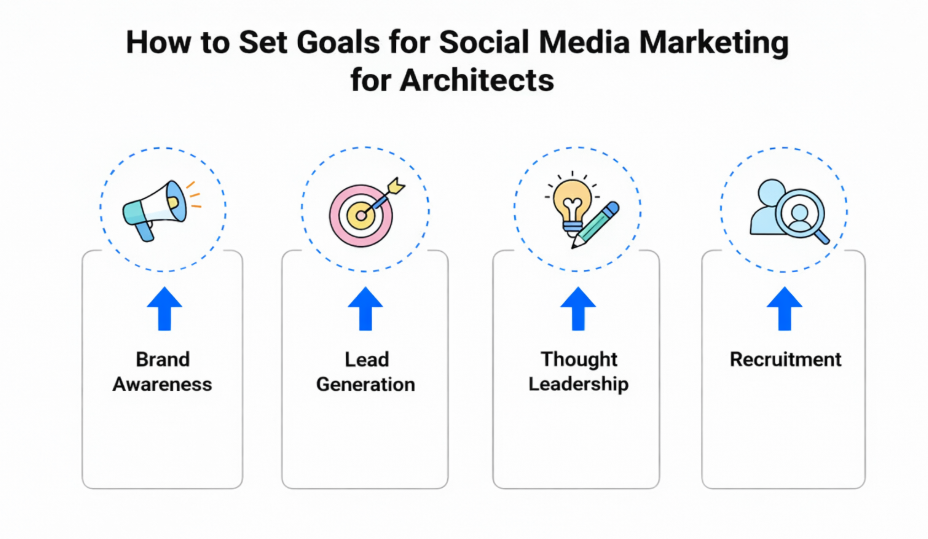
- Brand Awareness — Make sure developers in your city or sector recognize your name;
- Lead Generation — Get people to hit your website contact form or DM you about work;
- Thought Leadership — Build your principals’ rep as authorities in a focused area (passive house, renovations, etc.);
- Recruitment — Show off projects and culture so that good talent wants to join you.
Once you pick a goal, you need a way to measure it. Using the SMART framework keeps you honest. It forces you to ask if the goal is specific and if you can actually track progress.
How to Choose the Right Platforms for Social Media Marketing for Architects
Not every platform will help your firm. The key is to match the platform’s strengths with your business goals. Trying to manage too many accounts usually means none of them get enough attention.
Here is a practical look at the main options:
- Instagram: It is image-first. Use it for finished project photos, construction progress shots, and quick video clips. It is the standard platform for architectural work;
- LinkedIn: It is text-and network-based. Use it for sharing completed project details, announcing firm news, and publishing articles on design topics. It works well for reaching commercial clients and industry peers;
- Pinterest: It is discovery-based. Users search for ideas and save them. If you post project images, they can appear in these searches for months or years. It is useful for steady website traffic;
- Houzz: It is residential-focused. Users are there specifically for home design and renovation. If you work on houses, this is a direct line to potential clients.
Pick the two that align with your client base. Focus your energy there and keep the others as placeholders at most.
Content Strategy in Social Media Marketing for Architects
You cannot just post project photos and expect people to stay engaged. You need variety. A content strategy helps you cover different angles so your audience sees new things on a regular basis.
Finished Projects
This is your main content. Use high-resolution images that are properly lit and composed. Show the building from multiple perspectives and include detail shots. Poor photos will undercut the quality of your work.
Construction Process
Document how things get built. Photos of the site during framing, images of material samples laid out on a table, and scans of early sketches. This content is interesting to clients because most people do not see this part of the work.
Explanatory Content
Use posts to explain your design logic. A quick video or a series of images that walks through a design decision shows that you have a process. It builds confidence with potential clients.
People
Feature your staff. New hires, long-term employees, and even interns. When someone sees a face and a name, the firm becomes a group of people instead of just a logo. It helps with trust and recruitment.
Common Mistakes in Social Media Marketing for Architects
Architecture firms often make the same mistakes when they start using social media. Here is a list of what to watch out for, written without extra commentary.
- Posting irregularly. A burst of posts followed by silence confuses followers and lowers your reach. Steady, consistent posting works better than sporadic activity;
- Ignoring comments. When someone asks a question, and you do not reply, your firm looks unapproachable. Respond to engagement;
- Using too much jargon. Clients do not know industry terminology. Explain your work in plain language that they can understand;
- Posting low-quality images. Blurry or poorly lit photos make good architecture look bad. If you lack a professional photo, post a sketch or a detail shot instead;
- No call to action. Every post should tell viewers what to do next—visit your site, send a message, or read a case study. Without direction, they will scroll past.
What Metrics Matter in Social Media Marketing for Architects
Posting regularly is one part of the equation. The other part is paying attention to what happens after you post. Some numbers are just for show. Others tell you whether your content is actually working. Here are the metrics worth your time.
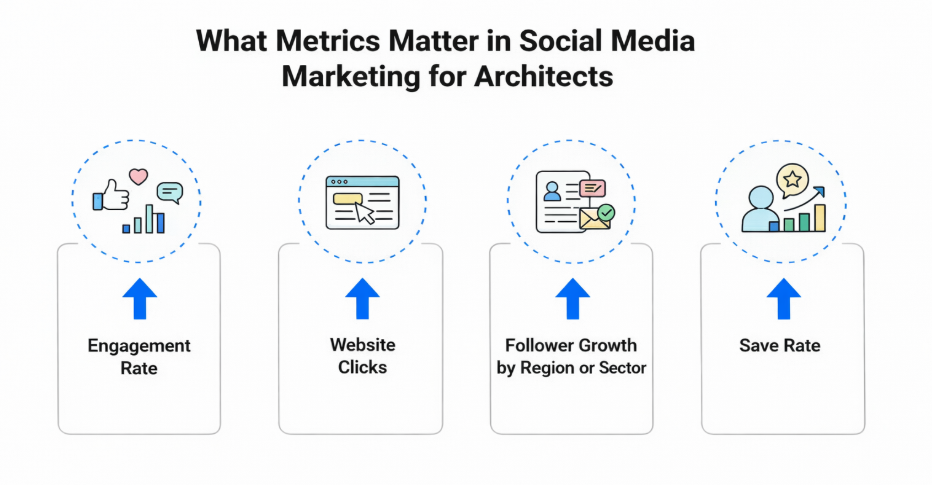
Engagement Rate
Take the total likes, comments, and shares on your posts and divide by your follower count. This percentage shows how compelling your audience finds your content. If this number is solid, people are stopping to interact instead of just scrolling past.
Website Clicks
Getting likes is fine, but you ultimately want people to leave the platform and visit your website. That is where they can see your full portfolio and contact you. Use UTM parameters to track exactly how much traffic each platform sends to your site in Google Analytics.
Inbound Leads
If you want to know whether social media is worth the effort, track your inquiries. Count DMs, emails, and form submissions, and write down which platform each came from. Skip this, and you are operating without data.
Follower Growth by Region or Sector
Looking at total follower growth is less useful than looking at where those followers are located or what industry they work in. If you are gaining followers in a specific city where you want more work, or among commercial real estate professionals, that is more valuable than random growth.
Save Rate
On Instagram, the save button matters. When someone saves a post, it means they found it useful enough to bookmark for later. This happens often with architectural photography and educational posts. A high save rate suggests your content has lasting value.
Tools for Social Media Marketing for Architects
You don’t need a lot of fancy equipment to keep up with social media, but the right social media marketing tools definitely make it easier to stay consistent. Here is a breakdown of the software and gear architects actually use to get the job done.
For visuals, Canva is the fastest way to throw together stories or mood boards — no graphic design degree required. When it comes to making your project photography look sharp and match, Lightroom or Photoshop is non-negotiable.
When it comes to posting, you might want to look at Later or Buffer. They let you map out your content ahead of time so you can see what your grid will look like. If you are juggling Instagram, LinkedIn, and Facebook, Hootsuite is useful for handling them all in one place.
For content creation, a drone has pretty much become standard gear. Aerial shots help show how a building actually relates to its site. And for quick videos like time-lapses or Reels, mobile apps like InShot or CapCut are easy and effective.
Сonclusion
Social media marketing for architects works because it makes complex design work understandable to potential clients. If you set clear goals, choose the right platforms, and post consistently—showing both finished projects and your process—you will attract the clients you want and build a reputation in the industry.
It takes time and effort, but putting your work in front of people visually is an opportunity you should not ignore.