A strong online presence isn’t optional anymore. That’s just how it is for healthcare practitioners. For chiropractors, it matters even more. Your work depends on trust and education. Social media lets you start building both before a patient ever walks in.
But setting up a Facebook page or Instagram account isn’t enough. Those are just the starting points. Without a strategy, they don’t help your practice grow. Social media marketing for chiropractors needs structure. You need to know what you’re doing.
Educate people about spinal health. Clear up misconceptions. Guide followers toward booking an appointment. When it works, your social media becomes the front door to your practice. In this article, we cover goals, platforms, content, and metrics. The goal is to turn followers into patients.
Why Social Media Marketing for Chiropractors is Essential
So why does social media marketing for chiropractors actually work? It comes down to the nature of the profession. Chiropractic care gets misunderstood a lot. People have questions. They hear things. And most potential patients don’t think about seeing a chiropractor until they’re already in serious pain.
By then, they’re looking for someone they can trust. Usually, that means asking friends, checking with family, or reading reviews.
Social media helps bridge that gap. It lets you show your expertise before they ever walk through your door. Here’s what that looks like:
- Share patient testimonials so people see real results;
- Explain the science behind adjustments in plain language;
- Give them a look at your office so they know what to expect.
All of that helps reduce the fear factor. Spinal manipulation sounds scarier than it actually is. When people see what really happens, they feel more comfortable booking.
There’s another piece too. A chiropractor who stays active on social media starts to feel familiar. When someone throws their back out doing yard work or gets into a fender bender, your practice comes to mind first. Not because you ran an ad, but because they’ve been seeing your content for months.
How to Set Goals for Social Media Marketing for Chiropractors
Before you post anything, figure out what success looks like. Without clear goals, social media marketing is just guesswork. You won’t know what’s working or where to focus.
The SMART framework helps. Specific, Measurable, Achievable, Relevant, Time-bound. It just means setting targets you can actually track.
Most chiropractic practices focus on three types of goals.
Awareness goals
These are about getting your name in front of people. A new practice might aim to gain 500 local followers in the first quarter. That keeps you focused on reaching potential patients within driving distance.
Engagement goals
These goals measure interaction. Likes, comments, shares—they signal to the platform that your content resonates.
You might aim for a 5% engagement rate on videos or focus on getting more DMs about booking appointments.
Conversion goals
This is the one that matters most. Social media needs to bring in patients. Track how many people fill out a new patient form from your bio link. Track how many calls mention a specific post. Those numbers tell you if your effort is actually paying off.
How to Choose the Right Platforms for Social Media Marketing for Chiropractors
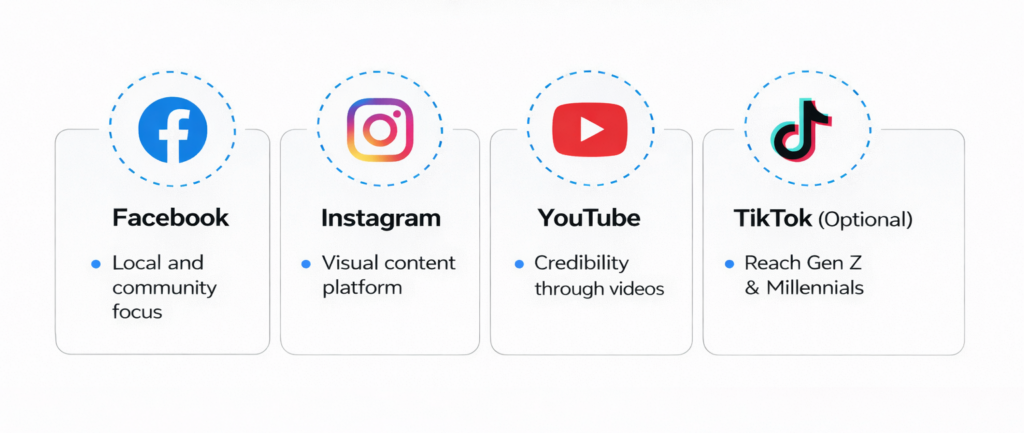
You don’t need to be on every social platform. Pick a few that actually make sense. That’s how social media marketing for chiropractors stays manageable and effective.
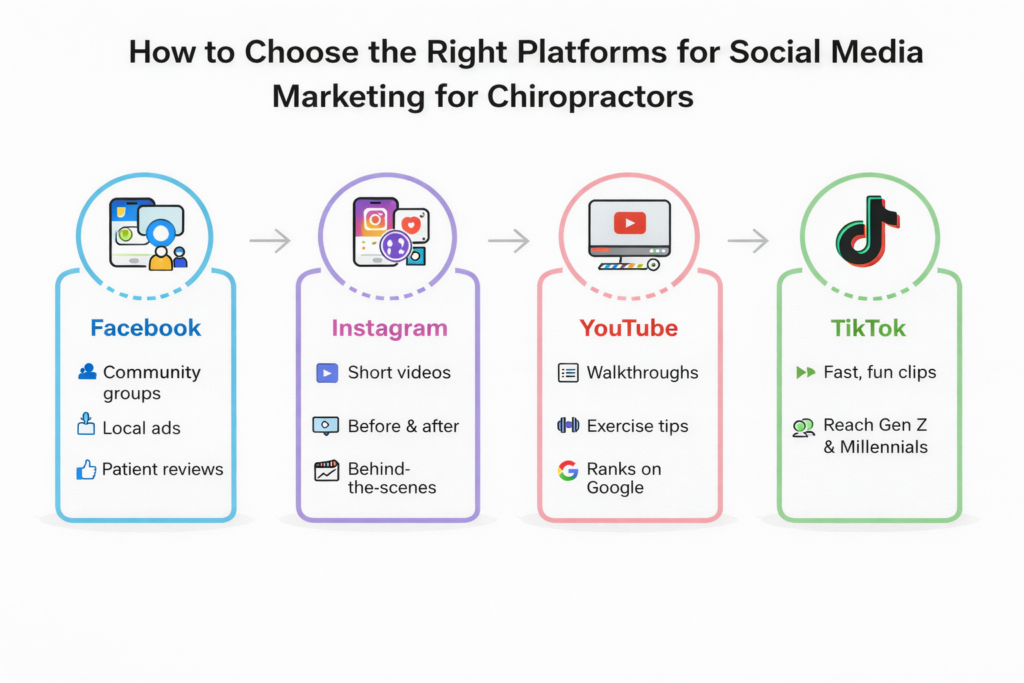
- Facebook. Local businesses rely on this. Community groups, office updates, patient reviews. Also, the best for geo-targeted ads to families and older adults;
- Instagram. Visual platform. Short videos, before and after stories, and behind-the-scenes clips. Reaches athletes, desk workers, and younger demographics;
- YouTube. The second-largest search engine. Video builds credibility. Long-form content, like first-visit walkthroughs or exercise tips, ranks on Google;
- TikTok. Optional. Short, fast videos work here. Debunk myths or show adjustments. Good for reaching Gen Z and Millennials if you have engaging content.
Content Strategy in Social Media Marketing for Chiropractors
Here’s what works for chiropractors. Your content needs variety. Walls of text about spinal anatomy? Not going to hold anyone’s attention.
Focus on three things.
Educational Content
This is where you answer real patient questions. Not anatomy lessons. The things people actually wonder about. Like whether cracking their own neck is dangerous or how to sit at a desk without wrecking their back.
Use video. Show an adjustment on a consenting patient. It takes the fear out of the process.
Social Proof
Nothing builds credibility like happy patients. Video testimonials give you that—real people from your area sharing their experience. It’s more persuasive than any advertisement.
Screenshots of 5-star Google reviews in your Stories work well too. Easy to do and keeps your reputation front and center.
Personal Connection
People want to know who’s about to put their hands on their spine. So show them. Introduce your front desk staff. Give a quick tour of your adjustment rooms. Share your own fitness routine or what you do outside the office. It makes your practice feel human instead of sterile.
Common Mistakes in Social Media Marketing for Chiropractors
Here are a few common mistakes in social media marketing. Even well-meaning practices make them, but once you know what to look for, they’re pretty easy to avoid.
- HIPAA violations. The most serious mistake. Posting X-rays without consent or mentioning patient names can lead to penalties. Always have written consent forms for any photos or videos;
- Inconsistent posting. Post a bunch one day and then vanish for weeks? Algorithms notice. So do potential patients. Regular posting builds credibility. Sporadic posting does the opposite;
- Over-promotion. Don’t turn your page into a classified ad. Constant hard selling pushes people away. Stick to the 80/20 rule — most content should be valuable, only a small portion should directly ask for the appointment;
- Ignoring comments and DMs. When someone reaches out, respond. Silence tells them you don’t care, and they’ll find someone who does.
What Metrics Matter in Social Media Marketing for Chiropractors
To refine your social media marketing strategy, you must measure performance. Vanity metrics—such as total page likes or follower counts—are often misleading. A page can have 10,000 followers but zero patients if those followers live in another country. Instead, focus on actionable metrics that correlate with clinic growth.
- Reach and impressions. Reach shows how many unique people saw your content. Strong reach within your local area means your brand is getting noticed by people who can actually become patients;
- Engagement rate. This is likes, comments, and shares divided by reach. A high rate means your content is resonating. Video retention is worth tracking too — especially on Instagram and TikTok, where watch time signals value to the algorithm;
- Click-through rate (CTR). Got a link to book appointments or fill out a new patient form? CTR tells you how many people are clicking through and taking that next step;
- Lead conversion. This is the one to watch. Track how many new patients mention social media when they call. Use a promo code, a separate phone number, or add a line to your intake paperwork.
Tools for Social Media Marketing for Chiropractors
Managing social media while running a busy clinic is tough. The right social media marketing tools can help. Here are a few that make social media marketing for chiropractors more manageable.
- Canva — Professional-looking posts without design skills;
- Buffer or Later — Batch & schedule content so you never miss a post;
- CapCut — Create engaging short videos quickly (with captions);
- Birdeye or Podium — Manage reviews/messages and book more patients automatically.
Clinics often can’t consistently manage social media themselves. Social media marketing outsourcing services handle content, scheduling, engagement, and tracking — so chiropractors can stay focused on treating patients.
Conclusion
A well-planned strategy is about more than staying current. It is about building a foundation for long-term practice growth.
Educational content demystifies chiropractic care. Patient success stories build credibility. Authentic community engagement establishes trust. Together, these elements create a steady stream of new patients who already feel confident in your care.
The approach is straightforward. Move beyond random posting. Set measurable goals. Select platforms where your target patients are active. Avoid legal pitfalls. Utilize tools to streamline repetitive tasks.
Social media offers a direct path from online follower to loyal patient.