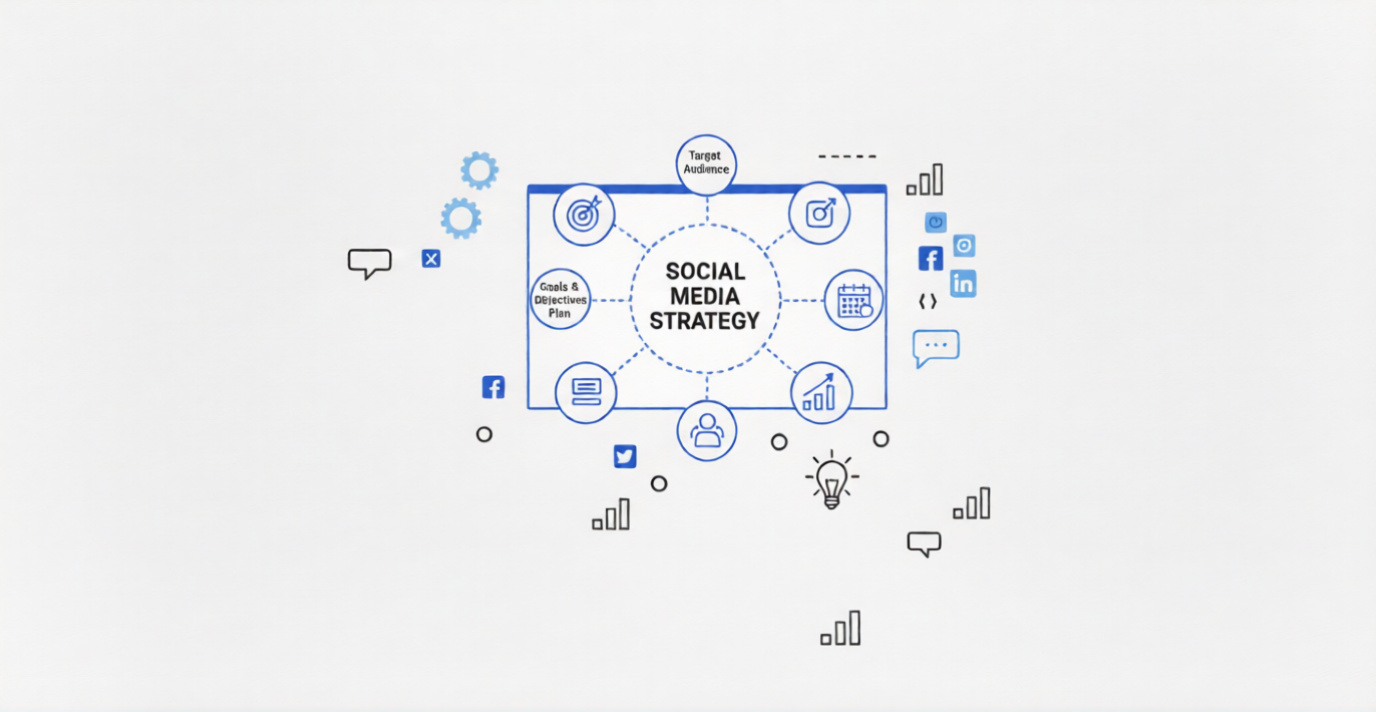
Think of a social media marketing strategy as a map drawn before the journey begins. It asks difficult questions early. Why are we here? Who needs to hear us? What does moving forward actually mean? Without this map, activity becomes a series of reactions. Teams post. They follow trends. Yet direction remains unclear, progress difficult to measure.
The quiet problem of having no real SMM plan is its gradual effect. Everything feels urgent but unimportant. Messages drift. Efforts scatter. A strategy, in contrast, creates intention. It defines the space a brand will occupy online and, more critically, the space it will not. This focus is everything in a landscape designed for constant distraction. It turns noise into a conversation. Random activity into a recognizable presence.
What Is Social Media Marketing Strategy
A social media marketing strategy is a way for a brand to decide what it is doing in social networks before activity starts to pile up. It answers a few basic questions that tend to get ignored when teams rush into posting: why this presence exists, what should change because of it, who the communication is meant for, and how progress will be judged later.
This has little to do with posting frequency or visual style. Strategy deals with direction. It sets limits. It draws a line between what belongs in social channels and what does not. That line matters because social platforms constantly push for reaction. New formats appear without warning. Trends move fast. Without a strategy, responding becomes the default behavior.
The absence of a strategy rarely causes immediate damage. It usually shows itself gradually. Messages lose consistency. Decisions start to feel rushed. Results become difficult to connect to the effort. Teams react to numbers without understanding why those numbers changed. A solid strategy reduces this drift by giving people something steady to refer back to.
Why Create a Social Media Strategy?
From the outside, social activity without strategy can look productive. Posts go out. Engagement appears. Campaigns launch. Yet when someone asks what all of this is actually leading to, answers often become vague. A strategy exists to remove that uncertainty.
A clear social media strategy is needed for several practical reasons:
- Clarity before activity. Strategy forces decisions early. It defines priorities and boundaries before urgency takes over. Attention, time, and budget are limited, and strategy decides how they should be allocated instead of reacting to pressure;
Alignment across teams. Social platforms sit close to branding, customer support, sales, and public perception. Without a shared plan, each area pulls communication in a different direction. Strategy keeps the voice steady even when many people contribute; - Restraint in a noisy environment. Not every trend deserves participation. Not every moment requires a response. Audiences notice consistency long before novelty. Strategy makes it easier to stay focused without constant second-guessing;
- Meaningful evaluation. Numbers alone explain very little. Metrics start to matter only when measured against goals defined in advance. Strategy provides that context and turns results into insight instead of confusion.
Without a strategy, social activity stays busy. With strategy, it becomes intentional.
Creating SMM Strategy Step-by-Step
Strategy almost never collapses because someone lacked ideas. It breaks earlier, in places most people rush through without noticing.
What usually goes wrong happens before anything is published. Decisions are half-made. Assumptions stay untested. Words sound reasonable but mean different things to different people. Later, all of this turns into constant fixing instead of steady progress.
This process works only when each step is treated as a real choice with consequences.
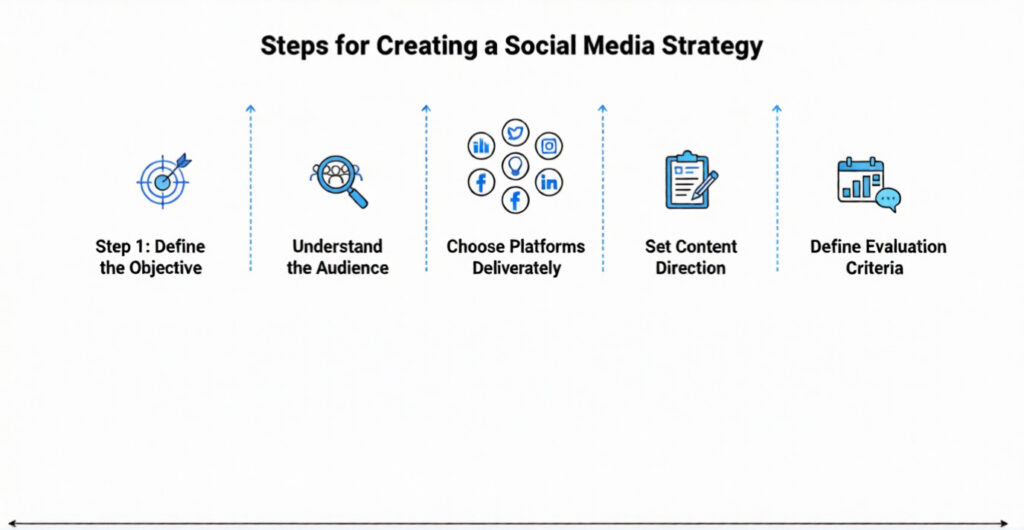
Step 1: Define the Objective
Everything begins with intent, not with channels, formats, or trends.
A strategy needs a clear sense of what is expected to change because social media is involved. That change might relate to visibility, demand, loyalty, or perception. Each option leads the work in a different direction. Tone shifts. Content choices shift. Even the meaning of “good results” shifts.
When objectives stay vague, activity fills the gap. Posting feels productive. Engagement looks encouraging. Yet nothing moves forward. A clear objective pulls decisions back toward purpose instead of motion.
Social media automation should serve that objective, not replace it. Tools that schedule posts, manage replies, or track mentions create efficiency, but they don’t create direction. Without a clear intent, automation becomes a way to produce more content that still lacks focus.
The risk is that speed and volume feel like progress while the work drifts further from what actually needed to change. Social media automation works best when it amplifies a strategy that already knows where it’s going.
Step 2: Understand the Audience
Audience work has little to do with profiles or segments. It starts with observation.
Inside social platforms, behavior tells the real story. What people ignore without slowing down. What makes them pause for a second. Where they react, comment, or save something for later. These moments reveal intent more clearly than any category label.
A strong strategy watches feeds the way people actually experience them. It notices patterns of attention and avoidance. That understanding allows content to meet people where they already are, rather than asking them to care.
Step 3: Choose Platforms Deliberately
Platform choice often looks simple and turns out to be expensive.
Being present everywhere feels reassuring, yet it spreads attention thin. Each platform has its own rhythm, expectations, and pressure on resources. Strategy should reflect where the audience truly spends time and what the team can sustain without cutting corners.
Deliberate selection creates room for depth. Patterns begin to appear. Recognition builds. Performance becomes easier to understand because effort is not scattered.
Step 4: Set Content Direction
Content direction is not a creative limitation. It is a stabilizer.
At some point, a brand needs to answer a quiet question: what do we keep talking about, even when nothing new happens? Themes, tone, and familiar formats create continuity. Over time, people recognize the presence before they register the name.
Without direction, messaging drifts. Posts chase relevance moment by moment. With direction, content can change shape without losing its sense of self.
Step 5: Define Evaluation Criteria
Measurement only works when it follows intent.
Numbers tell different stories depending on why the work exists. Reach, engagement, traffic, and conversions each point to different outcomes. Picking metrics because they are easy to track usually leads to the wrong conclusions.
Clear evaluation criteria narrow focus. They help separate movement from progress and keep reviews grounded in outcomes rather than opinions. When this part is clear, adjustment becomes thoughtful instead of reactive.
Social Media Strategy Examples
Examples work best when they reflect real operating conditions, not abstract models. Strategy changes not because of industry labels, but because attention, expectations, and decision speed are different.
Consumer Brands: Speed and First Impressions
For consumer brands entering a crowded market, the first challenge is simple: nobody waits. Unknown names are skipped without hesitation. Strategy in this environment usually prioritizes formats that communicate quickly and clearly. Short videos often become the foundation, not because it is fashionable, but because it shows context, tone, and product use within seconds.
The emphasis sits on familiarity rather than persuasion. Content aims to be recognizable before it tries to convince. Paid promotion plays a supporting role here, extending reach and ensuring repeated exposure while organic presence is still forming. Early success is measured by attention and interaction, not immediate sales.
B2B Companies: Trust Before Action
B2B strategy operates at a different pace. Attention is selective, and decisions rarely happen after a single touchpoint. Strategy reflects this reality. Content focuses on clarity, expertise, and relevance rather than frequency. Educational posts address specific problems, questions, or industry shifts that matter to professionals.
Platform choice follows behavior, not scale. Visibility among the right roles matters more than broad reach. Paid activity supports recognition within defined segments and reinforces messages over time. Results appear slower, but trust accumulates steadily.
Local Businesses: Familiarity Over Scale
Local businesses work within narrow geographic and social boundaries. Strategy here values relevance more than volume. Being seen repeatedly by the same audience matters more than reaching new people constantly.
Content often reflects everyday reality: customers, staff, local events, and daily operations. Interaction carries weight because it reinforces familiarity. Recognition builds through presence and responsiveness rather than campaign intensity. Paid promotion, when used, typically supports visibility within a specific area rather than expansion.
Despite the differences, the foundation stays consistent. Goals are defined early. Audiences are understood within their actual context. Platforms are selected deliberately. Execution follows direction rather than reacting to every new trend or format.
This consistency allows the strategy to remain stable even when tactics change. Formats evolve. Algorithms shift. The structure holds.
Role of Social Media Tools in Social Media Marketing Strategy
Social media tools help the strategy function. They do not create it.
Within a social media marketing strategy, tools handle coordination and visibility. They keep posting consistent, surface audience response, and make performance easier to review over time.
Their value becomes obvious as activity grows. Managing multiple platforms manually breaks down quickly. Tools reduce friction and prevent small tasks from consuming attention.
At the same time, tools should never lead decision-making. Dashboards tend to highlight what is easy to measure. Strategy keeps focus on what actually matters and uses tools only in support of that focus.
When chosen with care, tools simplify work and leave more room for thinking.
How to Implement a Social Media Marketing Strategy

Implementation rarely fails loudly. More often, it fades out quietly.
A strategy may be approved, shared, and even documented, yet still fail to take hold. The reason is usually simple: people do not know how to act when the document is no longer in front of them. Implementation begins at the point where the strategy has to work without constant reminders.
Build Shared Understanding First
Everything depends on how evenly the strategy is understood.
If only one person can explain it, the system is fragile. Decisions slow down. Small questions turn into approvals. Inconsistency appears the moment pressure increases. A strategy needs to live in people’s heads, not in a folder.
Shared understanding does not mean memorizing statements. It means that different people can make similar decisions when facing the same situation. When that happens, execution becomes steady even when conditions change.
Turn Direction Into Routine
Strategy only becomes real once it settles into routine.
Publishing rhythms, response habits, review moments — these small, repeated actions carry more weight than occasional bursts of activity. At this stage, consistency matters far more than ambition. Irregular intensity rarely builds anything lasting.
Routine removes friction. It replaces constant decision-making with momentum. Instead of asking what to do next, teams begin doing what already fits the direction.
Allow Time for Patterns to Appear
Early performance is misleading more often than helpful.
Initial spikes or drops rarely explain anything on their own. Patterns need time to surface. Audience behavior unfolds gradually. Adjustments made too quickly usually respond to noise rather than signal.
Regular review helps create distance. It allows teams to observe without reacting impulsively. Over time, meaningful trends separate themselves from short-term fluctuation.
Let Strategy Guide Everyday Decisions
Over time, implementation stops feeling like execution and starts feeling natural. Strategy shows up in small decisions — what gets posted, what gets skipped, and what gets revisited.
The Three Outcomes a Strong Strategy Consistently Supports
This final point explains why strategy matters beyond planning.
- Clear decisions when platforms, trends, or pressure compete for attention.
- A recognizable presence that audiences learn to trust over time.
- Progress that connects social activity with broader business goals.
These outcomes take time. They appear when strategy guides action repeatedly, not occasionally.
Where Strategy Actually Shows Its Value
This is where strategy proves whether it was worth the effort.
Over time, a strong social media strategy simplifies decision-making. When platforms change, trends compete for attention, or pressure builds to react quickly, choices become clearer. Not because answers are obvious, but because direction already exists.
Consistency follows. A brand begins to feel familiar. Not loud, not perfect, just recognizable. Audiences learn what to expect, and that expectation turns into trust through repeated, predictable presence.
Most importantly, progress stops feeling abstract. Social activity connects back to broader business goals instead of living in isolation. Results may take time, but they become easier to explain, evaluate, and adjust.
These effects do not appear overnight. They grow when strategy guides action again and again, not when it is referenced only when something goes wrong.