Running a business without social media has become a real handicap. Most potential customers check platforms before they buy or visit.
Entrepreneurs have noticed the change. You now have to do more than just exist online — you need to interact, sell, and grow a community around your brand.
With limited time and money, spreading yourself too thin across every app is a mistake. Precision and focus deliver much better results.
Here, we examine five modern social media marketing strategies for small businesses that drive actual revenue, not just vanity metrics. We provide a complete plan from goal setting to tool selection. This allows you to compete with larger brands through agility and authenticity.
Why Social Media Marketing for Small Businesses is Essential
Treating social media as an afterthought is a common mistake among owners. In reality, social platforms have become a main channel where customers discover and assess businesses. Research indicates that following a brand on social media increases purchase likelihood.
For small companies, this is huge. You don’t need a Super Bowl budget. A single viral testimonial or smart local hashtag can drive real results. You can show the human side of your brand in a way big corporations struggle to copy.
Instagram and TikTok now make buying even easier with “Shop Now” buttons. The gap between seeing and buying has never been smaller.
Skip social media, and your business becomes much harder for potential customers to notice online.
How to Set Goals for Social Media Marketing for Small Businesses
Strategy without a goal is just a wish. Too many small businesses chase “more followers,” only to realize those followers never buy anything. Effective social media marketing strategies for small businesses rely on the SMART framework (Specific, Measurable, Achievable, Relevant, Time-bound).
First, distinguish between brand awareness and conversion. For example, a new coffee shop might aim for “50 Instagram Story check-ins in the next 30 days” to drive foot traffic. An online store, on the other hand, could target “100 link clicks to the product page every week.”
Instead of obsessing over big follower counts, focus on micro-conversions.
A 5% engagement rate or 20 DMs asking about pricing tells you far more about future sales. A plumber might track “10 saved posts per month” because people save repair tips for when they need them.
Tie your goals to cash flow. Service businesses (like salons or contractors) should track booking form submissions. Product businesses should watch cart additions. Write your goals down and check them every week.
How to Choose the Right Platforms for Social Media Marketing for Small Businesses
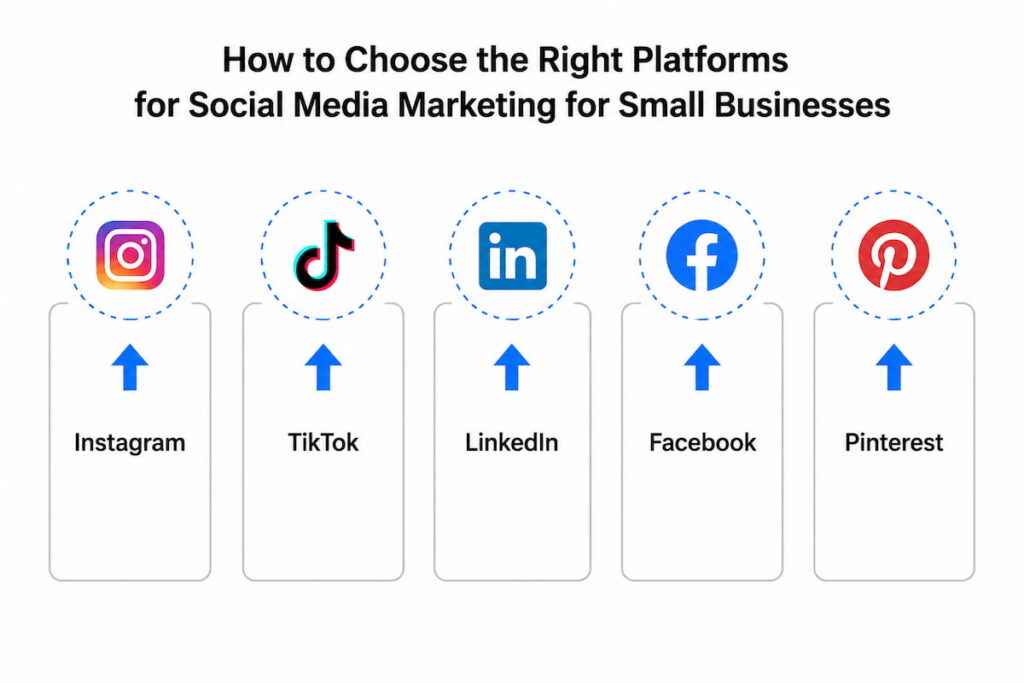
The biggest mistake small businesses make with their social media marketing is trying to be present on every platform. Many businesses waste their budget on platforms where their target customers are not active. Your platform selection must follow a clear logic: focus on where your customers actually spend time and what content you can consistently produce.
Here is the modern breakdown for social media marketing strategies for small businesses:
- Instagram: Best for visual products. Use Reels for reach and Stories for daily reminders;
- TikTok: Best for personality-driven brands. The algorithm favors small accounts;
- LinkedIn: Essential for B2B. Post articles and comment on industry leader posts. To streamline outreach and connection requests on this platform, many B2B brands rely on specialized linkedin automation tools to scale their lead generation efficiently;
- Facebook: Effective for local businesses. Use Local Buy/Sell groups and Events;
- Pinterest: Drives long-term traffic. One pin can generate clicks for six months.
The rule of thumb: Start with two platforms. Master them completely. Only add a third when you have systems in place.
Content Strategy in Social Media Marketing for Small Businesses
Content is the fuel, but structure is the engine. A common myth is that you need a professional video crew. In reality, the most effective social media marketing strategies for small businesses rely on “Raw & Real” content.
Consumers today distrust overly polished ads. They trust shaky, on-the-floor iPhone videos showing how a product is made.
Follow this simple 5-3-2 rule to keep your feed balanced:
- 5 educational or entertaining posts (tips, how-tos, relevant memes)
- 3 curated posts (customer reviews or partner content)
- 2 promotional posts (offers or product launches)
Focus more on storytelling than selling. Show why your product matters instead of just pushing it. For videos, keep it short: hook viewers immediately, give them something useful, then tell them what to do next.
User-generated content is also a game changer. Encourage customers to share their own photos with your product. A simple contest offering a discount in return can generate authentic trust very quickly.
Common Mistakes in Social Media Marketing for Small Businesses
Even with the best intentions, small businesses often sabotage their own growth. Here are the five fatal errors ruining your social media marketing strategies for small businesses right now:
- The “Spray and Pray” Mistake: Copy-pasting the same content across Instagram, LinkedIn, and TikTok kills your reach. Each platform favors native content—so reformat or pay the price;
- The Ghosting Trap: Ignoring DMs for days destroys customer trust. No response = no sale. Set up an auto-reply or a business hours disclaimer immediately, and when you move conversations to email, use email validation to ensure your messages reach valid inboxe;
- Inconsistent Posting: Going hard for one week and silent the next. The algorithm hates this. Steady, quality posts (even just 3 per week) work far better;
- Buying Followers: This is a classic trap. Fake followers destroy your engagement and make the algorithm bury your content. Real customers notice them immediately;
- No Call to Action: Posting without telling people what to do next. Every post should gently guide them — like “Link in bio” or “Share with a friend.”
What Metrics Matter in Social Media Marketing for Small Businesses
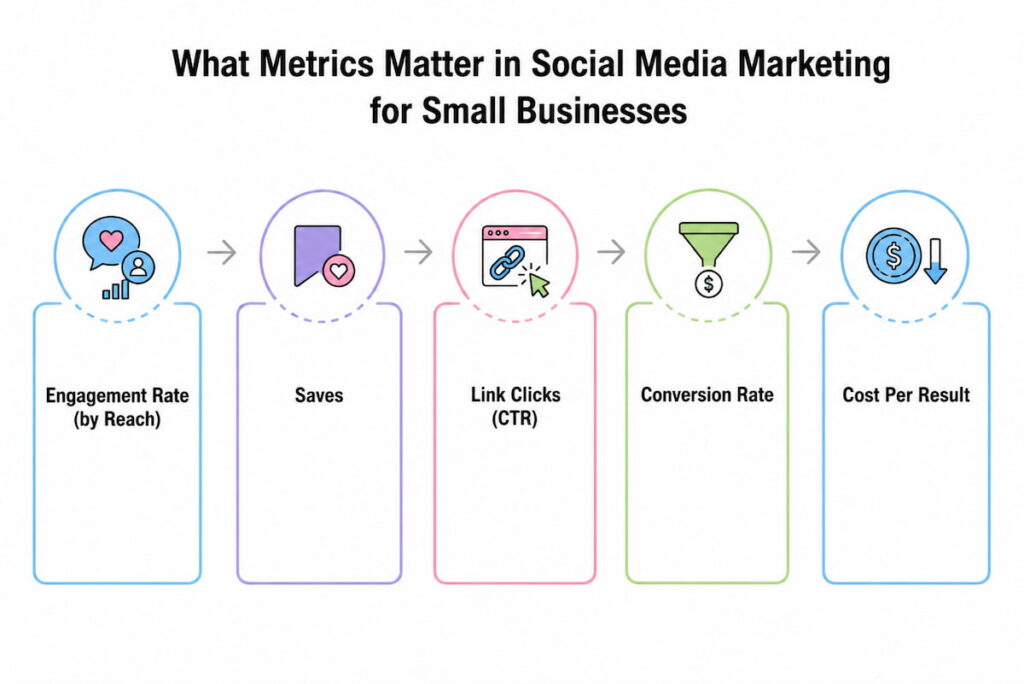
You have heard of “Likes.” You have heard of “Shares.” But if you want to survive, you need to ignore the ego metrics and focus on business metrics. When analyzing your social media marketing strategies for small businesses, open your analytics dashboard and look for these five KPIs only:
Engagement Rate (by Reach)
How many unique people saw your post vs. how many interacted. Aim for 3-5%. If it is lower, your content is boring. If it is higher, you are winning.
Saves
This is the new “Super Like.” When someone saves your post, the algorithm believes you are a resource. High saves mean you are providing utility (recipes, tutorials, checklists).
Link Clicks (CTR)
Specifically, how many people clicked the link in your bio or the “Shop Now” button. This is your traffic health.
Conversion Rate
How many clicks turned into purchases or email signups. Use UTM parameters (free tools from Google) to track this.
Cost Per Result (if paid)
For small budgets, you need to know if you are paying 0.50 per click or 5.00 per click.
Pull those costs into your financial reporting tools each month to see how paid spend affects your margins.
Ignore “Follower Count” for the first 90 days. Focus on “Saves” and “DMs.” A person who saves your post is 10x more valuable than a passive follower.
Tools for Social Media Marketing for Small Businesses
You cannot spend ten hours per day on manual posting, as that is not realistic. Effective growth requires automation tools to help you produce content faster. This applies directly to developing social media marketing strategies for small businesses.
These tools are practical, mostly free or cheap, and actually make life easier:
- Canva for design — use the Magic Resize feature to adapt one post across platforms in seconds. Their templates save tons of time;
- Later or Buffer for scheduling — they analyze your past performance and suggest the best posting times;
- CapCut for videos — it adds captions automatically and includes trending sounds, which helps a lot with reach;
- ManyChat or MobileMonkey for DMs — create keyword triggers so customers get instant answers even when you’re not around;
- Google Analytics + UTM codes — so you can see which posts are actually leading to sales.
And here’s a useful tip: ChatGPT (free version) can spit out dozens of caption ideas in under a minute. Just edit them afterward so they sound human and authentic to your brand.
Conclusion
The big brands are slow. They require three weeks of legal approval to post a meme. You, the small business owner, can decide on a strategy at 9 AM and post a video by 10 AM. That agility is your superpower.
The five social media marketing strategies for small businesses outlined here—goal setting, platform selection, raw content, avoiding mistakes, measuring saves, and using free tools—are not theoretical. They are the daily practices of the fastest-growing local shops and online side hustles.
Start by selecting one neglected platform and updating your bio. Film a 15-second video that answers your most common customer question, then post it and reply to every comment. This single action typically generates a higher ROI than 90% of paid ads. Your customers are scrolling now, so you should engage them immediately.