These days, the fitness scene is packed. Everyone from small boutique studios to big gyms and online coaches is competing for the same local members.
A solid location helps, but it’s not enough on its own. The gyms that grow are the ones with a digital presence that actually brings people in.
That’s why social media marketing for gyms has become essential instead of optional. Most potential members research you online first — scrolling feeds, watching videos, and checking reviews. If you’re not showing up, you’re losing leads quietly every week.
We’ve put together a straightforward strategy to help your gym stand out, from setting the right goals all the way to measuring what works.
Why Social Media Marketing for Gyms is Essential
Many gym owners view social media as a burden—a necessary evil to post “Motivation Monday” quotes. However, when executed correctly, social media marketing for gyms acts as a 24/7 sales funnel. It offers three distinct advantages that traditional advertising cannot match.
Visual Proof of Social Proof
Fitness relies heavily on visuals. Videos of real clients hitting personal records or group classes working out help build trust. Unlike TV commercials, your Reels clearly show what your gym is actually like. Prospects make quick decisions based on that.
Community Building Before the Sale
Feeling intimidated is a big barrier for new members. Social media helps break it down. After following your page for a couple of weeks and seeing coaches and staff, new members arrive already knowing what to expect. This reduces churn right from the start.
Cost-Effective Lead Generation
Costs for Google Ads in fitness keep rising. A mix of organic social content and hyper-local ads often gives stronger returns. Sharing transformations and daily schedules attracts people who are ready to join.
How to Set Goals for Social Media Marketing for Gyms
You can’t improve what you don’t measure. So before you film your first workout video or post a single piece of content, get clear on what success actually looks like for your gym.
Likes and comments might feel good, but they’re often vanity metrics. Real success comes when your social media efforts bring people through your doors. That’s why your goals need to stay tightly connected to actual business results — not just online engagement.
The smartest way to do this is by using the SMART framework: Specific, Measurable, Achievable, Relevant, and Time-bound. Here’s how that looks in practice for a gym:
- Lead Generation Goal: Generate 50 DM inquiries or form submissions per week from Instagram Reels;
- Member Retention Goal: Boost the number of member check-ins shared in Stories by 20% this month to get more user-generated content flowing;
- Trial Conversion Goal: Drive 30 new 7-day trial pass downloads through your Facebook bio link during Q3.
Pro Tip: Skip the generic “gain more followers” goal. A thousand new followers from another country won’t fill a single class. Instead, focus on people who actually matter — those living within five miles of your gym — and the actions you want them to take, like tapping the “Book a Tour” button.
How to Choose the Right Platforms
Choosing the right platforms can feel overwhelming, but you don’t need to be everywhere at once. Focusing on too many will exhaust your staff and hurt your quality.
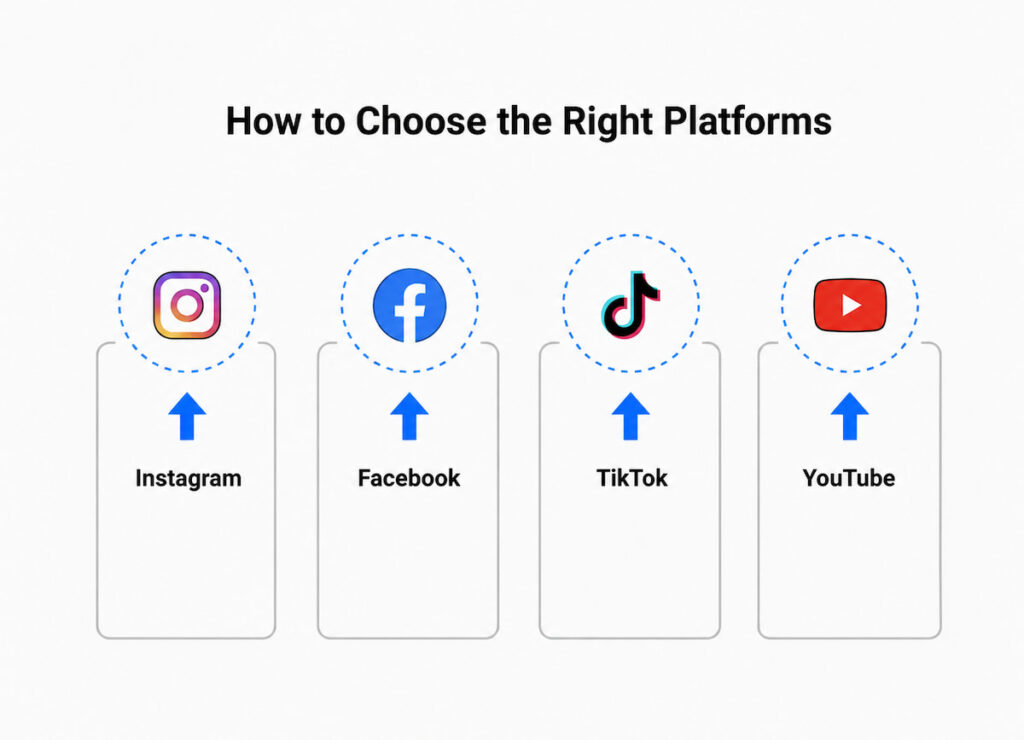
The key is matching platforms to your typical members and the content you can actually keep up with:
- Instagram: Absolutely essential. It acts as your gym’s visual resume — clean grid posts for transformations, Stories for day-to-day updates, and Reels for quick how-tos;
- Facebook: Still powerful for the 35–55 demographic that tends to spend more. Build a members-only group and use it to promote local events;
- TikTok: Ideal if you’re targeting younger crowds and want viral potential. A simple coaching moment can reach thousands in your area overnight;
- YouTube: Great for longer, detailed content like full workouts or seminars that position you as an authority.
The Verdict: Prioritize Instagram and Facebook first. Add TikTok down the line only if you’ve got someone who enjoys being on camera consistently.
Content Strategy in Social Media Marketing for Gyms
Content plays a major role in social media marketing for gyms. But many gyms struggle because their posting strategy is inconsistent — a meme on Monday, a quote on Tuesday, and a random selfie on Wednesday. To get better results, you need a structured content pillar system.
Divide your content into three buckets:
Pillar 1: Educational (40%)
Show your expertise. Teach the audience something they didn’t know.
- Idea: “3 things you are doing wrong on the lat pulldown.”
- Idea: “Why you need protein within 30 minutes of training.”
- Format: Carousels or voiceover Reels.
Pillar 2: Social Proof (40%)
Let your results speak. This is where social media marketing for gyms generates trust.
- Idea: Client of the week interview;
- Idea: Time-lapse of a small group training session (with consent);
- Idea: “Day 1 vs. Day 30” transformation;
- Format: Testimonial text overlays or video diaries.
Pillar 3: Culture & Humor (20%)
Show the human side. Let your trainers be goofy. Show the messy back office. People join people, not equipment.
- Idea: “POV: The front desk forgot to refill the paper towels”;
- Idea: Coach trying a member’s favorite exercise;
- Format: Raw, unpolished Stories.
The Golden Rule: Always end with a Call to Action (CTA). “Comment ‘READY’ for the free workout plan.” “Click the link in bio for a free week.”
Common Mistakes in Social Media Marketing for Gyms
Even well-intentioned gym owners make errors that kill their organic reach. Avoid these three landmines at all costs.
Mistake #1: Posting Without a Hook
You have 0.5 seconds to stop the scroll. If your first frame is a blurry floor mat, the user scrolls past. Always open with a visual hook (a heavy weight dropping) or a text hook (“Most people leg press wrong…”).
Fix: Film the final rep of the set first, then rewind. Lead with the climax.
Mistake #2: Ignoring the Bio Link
Your bio is prime real estate. Do not just put a generic “www.mygym.com/contact”. That is friction. The user has to click, load, scroll, find a contact, fill a form… they won’t do it.
Fix: Use a Linktree or Beacons page. Label the link clearly: ” Get Your Free Week Pass ” or ” Call to Speak to a Coach.”
Mistake #3: Being Afraid of Negative Comments
Some gyms delete every critical comment. This looks suspicious. A few negative reviews or questions (responded to politely) actually increase credibility. It shows you are a real business.
Fix: Reply publicly to negative comments with empathy. “Hey John, sorry to hear that. DM us your number so we can fix this.” This shows great customer service to onlookers.
What Metrics Matter in Social Media Marketing for Gyms
You can’t rely on vanity metrics like total likes if you want your social media to actually move the needle for your gym. Instead, keep an eye on the data that shows real business impact.
These are the metrics that matter most:
- Engagement Rate (Saves & Shares): Likes are passive. Saves and shares show genuine interest. People saving your Reels plan to try the workout — aim for 4-6% saves;
- Link Click-Through Rate: How many actually click your bio link or swipe up for a free pass? If the number is low, your CTA probably needs fixing;
- DM Volume: Keep tabs on incoming messages asking about pricing or tours. This is often the best early indicator of serious leads;
- Reach vs. Impressions: You want a growing reach to new local people, not the same small group viewing your content over and over;
- Cost Per Lead: Know what you’re paying per lead on ads. A $100 campaign that delivers 10 leads costs you $10 each — use this to guide smarter spending.
Tools for Social Media Marketing for Gyms
Managing a fitness page manually is exhausting. Use automation and scheduling tools to reclaim your time while maintaining consistency. Many gyms eventually start outsourcing social media marketing to keep content, replies, and posting schedules consistent without overloading trainers or front desk staff.
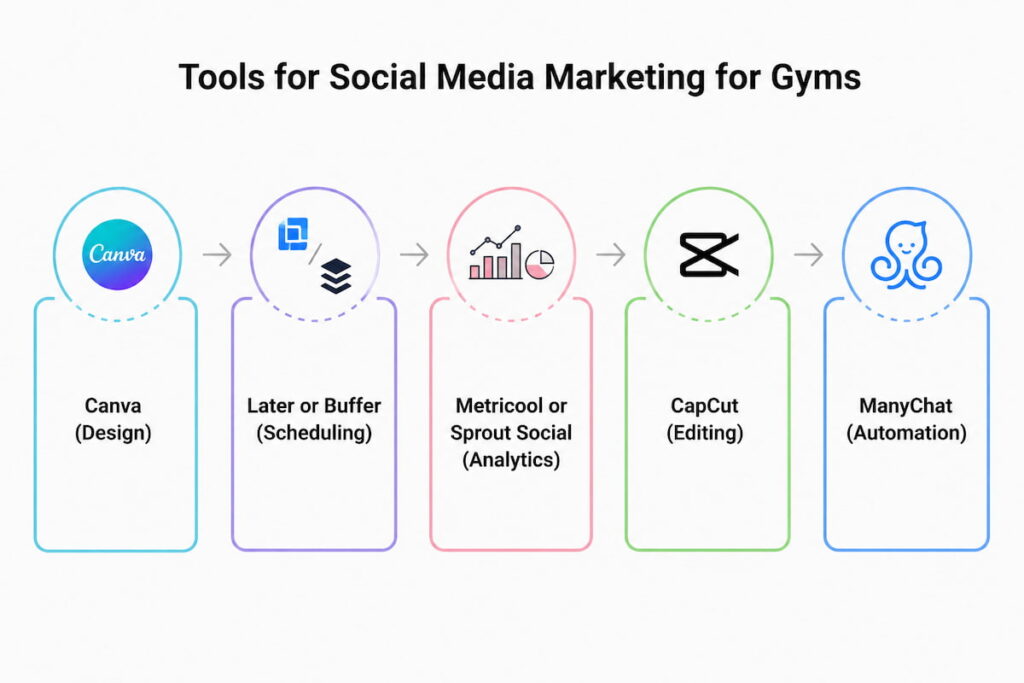
Canva (Design)
The free version is usually enough. Use their “Instagram Story” templates to overlay class times on videos quickly. Create branded templates for “Monday Motivation” so you aren’t starting from scratch.
Later or Buffer (Scheduling)
Spend one hour on Sunday scheduling the week’s educational posts. This ensures you never miss a day due to a busy floor. Leave the “real-time” stories (culture content) for during the shift.
Metricool or Sprout Social (Analytics)
Find out exactly when your followers are online (usually 5-7 PM for gym audiences). Schedule your posts for 15 minutes before that peak window.
CapCut (Editing)
The industry standard for gym Reels. It has automatic captions (crucial for silent viewing) and easily accessible speed ramping for lifting videos.
ManyChat (Automation)
Automate your DMs. When someone comments “PRICE”, ManyChat instantly sends them a preset message with your rates and a link to the waiver. This converts leads while you sleep.
Conclusion
You don’t need a huge budget or a fancy degree to make social media marketing for gyms work effectively. What matters most is consistency, authenticity, and focusing on your members’ journey.
Start small. This week, post one educational Reel and three Stories daily that show the real vibe of your classes.
Next week, add a client spotlight. Then run a simple $50 Facebook ad aimed at locals within two miles.
The gyms that survive and grow will be those with active digital communities — not just the best equipment. Grab your phone, start filming, and watch your membership numbers climb.