The financial advisory business is built on trust, credibility, and long-term relationships. But advisors today face a real challenge. Your potential clients expect to find you online, yet your work requires a level of compliance that other industries do not have.
To manage this, you need a clear strategy. That is what makes social media marketing for financial advisors a core part of business development.
Golf outings and cold calls do not work like they used to. Millennials and Gen Xers entering their peak earning years use social platforms to research advisors before they reach out.
In this guide, we provide a practical roadmap for building a compliant, effective, and profitable social media marketing for financial advisors strategy.
Why Social Media Marketing for Financial Advisors is Essential
Social media isn’t optional for financial advisors anymore — it’s one of the main ways people find you.
The industry is full of advisors. If someone searches your name or your firm and gets nothing useful — or just an old, empty LinkedIn profile — they’re already questioning whether you’re active or relevant. You lose ground before the conversation even starts.
Using it consistently gives you three clear advantages.
First, it shows you know what you’re talking about. Regular posts with market updates, basic explanations, or useful tips make you look competent and current.
Second, you can see what people are actually asking about — retirement, taxes, investing — and answer in the comments or threads without sounding like an advertisement.
Third, it makes your practice feel less stiff. Compliance keeps most communication pretty formal, but social media lets you post about your team, local events, or just normal updates that show you’re a real person running a real business.
How to Set Goals for Social Media Marketing for Financial Advisors
Define success before you start posting. Vague goals like “getting more followers” are vanity metrics. They look nice but do not bring in business. Effective social media marketing for financial advisors connects to actual business objectives.
Use the SMART framework. Goals need to be Specific, Measurable, Achievable, Relevant, and Time-bound.
For example, instead of growing on LinkedIn, set a goal like “Schedule ten discovery meetings per quarter from LinkedIn outreach.”
Common goals for advisors include:
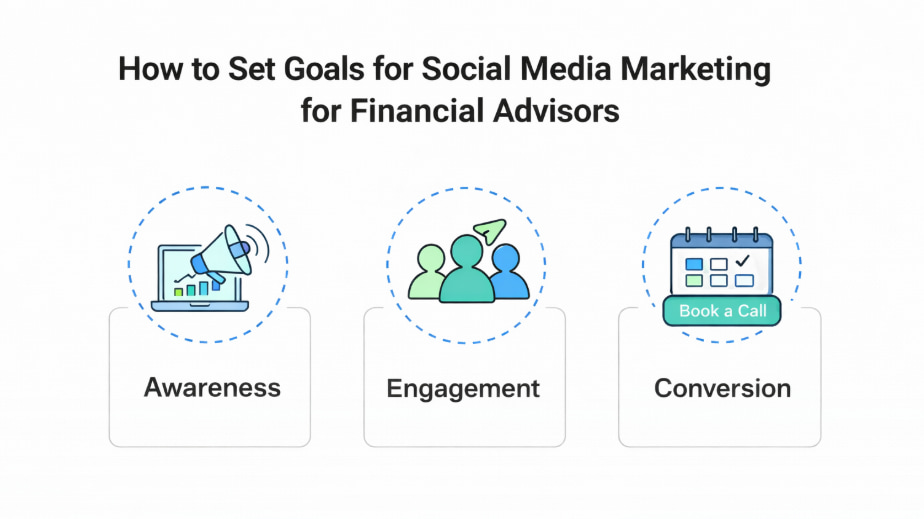
- Awareness: Increasing website traffic or content downloads (e.g., a retirement checklist);
- Engagement: Building a community of local professionals (CPAs, attorneys) who refer business;
- Conversion: Booking initial consultations directly through a “Book a Call” link on Instagram or LinkedIn.
Your goals will dictate your social media marketing strategy. If your goal is referrals from COIs (Centers of Influence), LinkedIn is your arena. If your goal is connecting with younger families just starting to invest, Instagram or even TikTok may be your battleground.
How to Choose the Right Platforms for Social Media Marketing for Financial Advisors
Not every platform makes sense for a regulated professional. Trying to be everywhere at once is a fast track to burnout, and the results usually suffer for it. Instead, you want to pick platforms based on where your ideal clients actually spend their time.
LinkedIn is still the foundation for most advisors. It is where business owners, executives, and high-net-worth individuals go to connect.
On top of that, it tends to be the most compliance-friendly option out there. If you are sharing nuanced financial insights, LinkedIn handles that well.
Instagram serves a different purpose. It works best for lifestyle-focused branding. Advisors who are targeting younger clients—people in their accumulation years—often find success here. It is also a good fit if you want to showcase your firm’s culture.
With features like Reels and Stories, you can take complex topics like compound interest or required minimum distributions and turn them into short, visual content that people actually watch.
Facebook has not gone away. For advisors who work with retirees or pre-retirees, it is still a useful platform. Local community groups can be a good place to demonstrate your expertise. These groups feel less formal than a seminar, and that can make it easier to build trust.
X
Twitter, now X, can be useful for real-time market commentary. But there is a catch. It takes a high volume of posting to get any traction, and if you are not monitoring it carefully, the reputational risk is higher than on other platforms.
For most advisors, the smart move is to master LinkedIn and pick one visual platform—either Instagram or Facebook. That is usually enough to get a strong return without spreading yourself too thin.
Content Strategy in Social Media Marketing for Financial Advisors
Your content strategy needs a clear focus. The goal is to educate, not to sell. If you constantly post “Open an IRA with me today,” you will lose people. That kind of promotion does not land well.
Follow the Rule of Thirds for content:
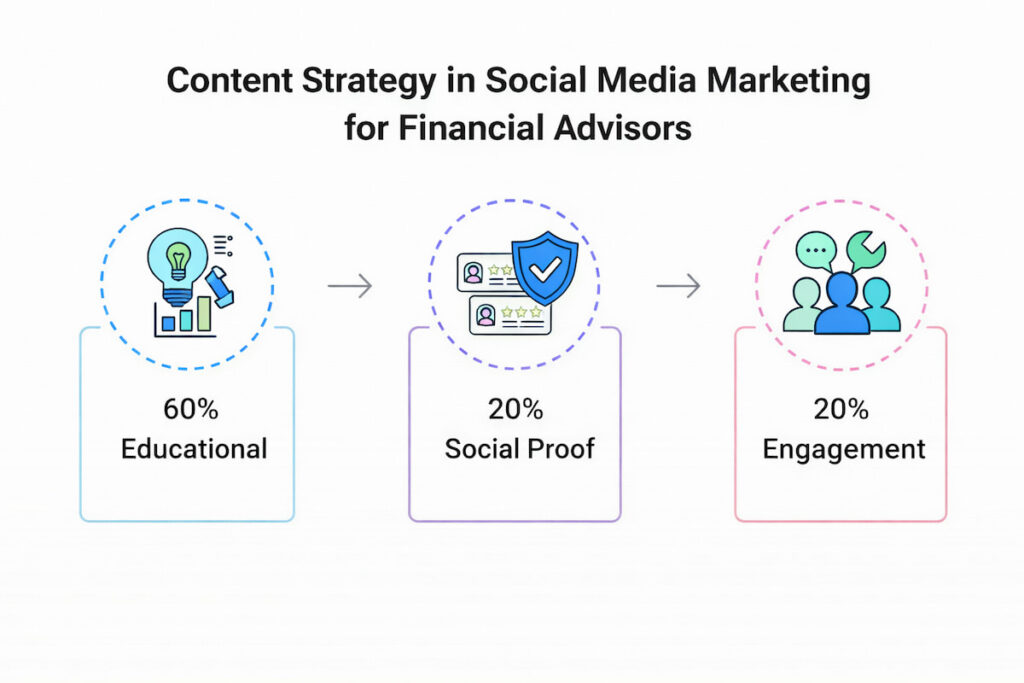
- 60% Educational — address pain points: tax-loss harvesting, asset allocation, market volatility. Demonstrates expertise;
- 20% Social Proof — include permitted testimonials, firm results, community/charity activity, and behind-the-scenes;
- 20% Engagement — interact on others’ content: thoughtful comments, congratulations, replies. Builds familiarity naturally.
Run all content through compliance review. Ensure it’s fair, balanced, and archived as required.
Common Mistakes in Social Media Marketing for Financial Advisors
Even capable advisors make mistakes. The most frequent one is inconsistency. Posting a lot one week and then nothing for months confuses algorithms and loses audience interest. Regular posting is more effective than occasional heavy posting.
Being too promotional is another issue. Social media is a pull channel. Push sales language too hard, and you push people away. Instead of “I manage money,” try “I help families navigate market uncertainty so they can retire with confidence.”
Compliance often gets overlooked. Advisors create content and then scramble to get it approved later. Sometimes posts get taken down. Pre-approval workflows make compliance easier.
Failing to engage is the last mistake. Posting and logging off is just broadcasting. Replying to comments and sending a quick thank-you builds real connections.
What Metrics Matter in Social Media Marketing for Financial Advisors
Likes are nice, but they do not translate into business growth. To justify the time and budget spent on social media, focus on metrics that tie to revenue.
- Conversions. Discovery calls and consultations booked through social channels. Use Calendly or Salesforce to track lead sources;
- Engagement. Comments, shares, and saves. A save indicates a user found the content useful enough to revisit;
- Website Traffic. Use UTM parameters or Google Analytics. Monitor visits to “About” and “Contact” pages;
- Click-Through Rate. For ads and links, CTR shows whether the message prompts action;
- Audience Growth. Secondary. Track follower growth within the target geography or industry as a brand health indicator.
Tools for Social Media Marketing for Financial Advisors
Managing a compliant, consistent social media presence manually is difficult. There are tools available that are designed specifically for financial advisors.
Compliance and Archiving
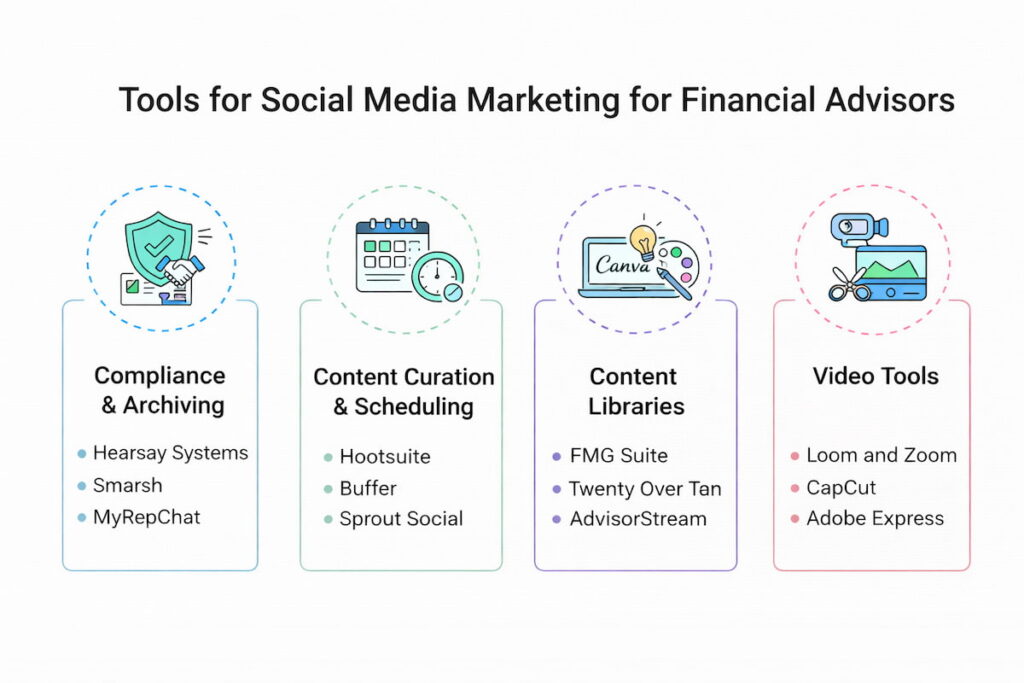
Tools like Hearsay Systems, Smarsh, and MyRepChat are essential. They integrate with your broker-dealer or RIA compliance department to automatically archive all communications and pre-approve content.
This is the non-negotiable layer of social media marketing for financial advisors.
Content Curation and Scheduling
For scheduling, Hootsuite, Buffer, and Sprout Social let you plan posts across multiple platforms. Many advisors prefer using LinkedIn’s native scheduling for professional content.
For visuals, Canva is a popular choice. It makes it easy to create graphics and short videos that simplify complex financial concepts.
Content Libraries
Not every advisor has time to write posts from scratch. Services like FMG Suite, Twenty Over Ten, and AdvisorStream offer pre-written, compliant content that advisors can customize and post. This helps you stay visible without spending hours on writing.
Video Tools
Video tends to get strong engagement. Loom and Zoom are good options for recording quick market updates or short educational clips. For editing, CapCut and Adobe Express are reliable social media marketing tools. They let you create short-form videos like Reels, Shorts, or TikToks that explain complex financial topics in 60 seconds or less.
Conclusion
The way advisors bring in new clients has changed. Trust is no longer built only through formal meetings. It comes from consistent, valuable, and compliant online engagement. When done right, social media marketing for financial advisors helps shorten the sales cycle, establish authority, and connect with younger investors.
Success does not require viral fame. What works is a disciplined approach: set clear goals, pick the right platforms, stick to a compliant content strategy, and measure what leads to booked meetings. Avoid common pitfalls and use the right tools.
That shifts social media from a regulatory burden into a reliable growth tool for your firm. Start small, stay consistent, and focus on delivering value. The results will come.