Startups have small budgets and small teams. Traditional ads are out of reach. So social media isn’t optional. It’s your best shot. Why? Because it levels the playing field. One clever post from a tiny team can easily beat a million-dollar corporate campaign.
That said, diving in without a strategy often causes burnout. In this guide, we offer a clear roadmap for social media marketing for startups — helping you set the right goals and focus on metrics that truly matter.
Why Social Media Marketing for Startups is Essential
Speed and agility are a startup’s best weapons. Social media plays right into that. You can test ideas quickly, build a real community, and get traffic without traditional marketing costs.
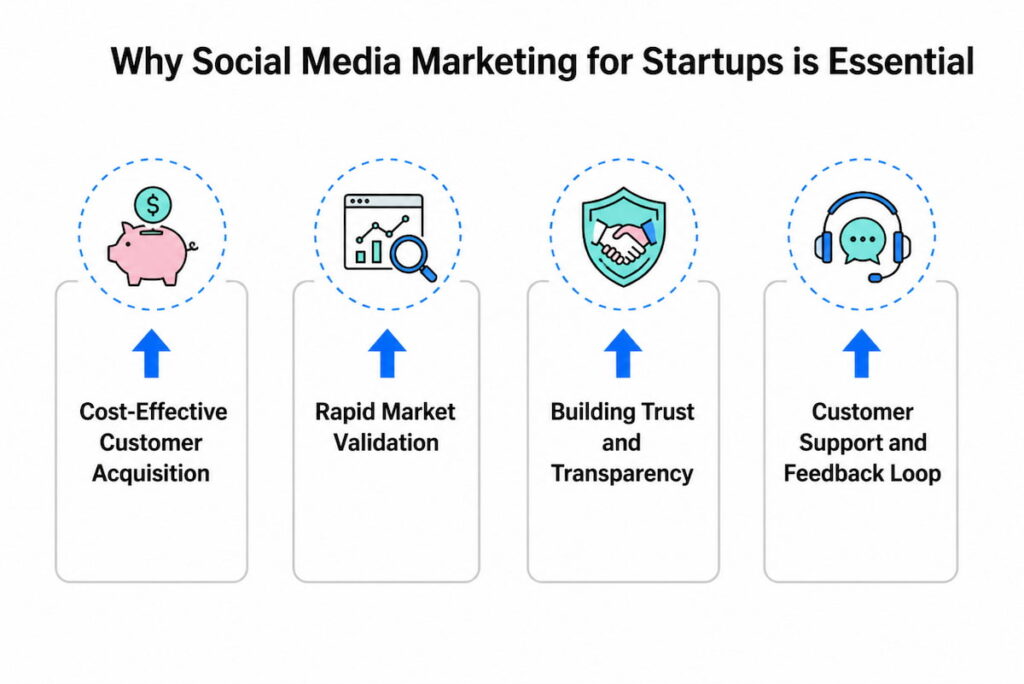
1. Cost-Effective Customer Acquisition
To begin with, it’s one of the most budget-friendly customer acquisition channels available. Startups usually can’t win bidding wars on Google, but organic social costs almost nothing except time. Paid social ads also have a low entry point — you can run meaningful tests with small budgets on Meta and LinkedIn.
2. Rapid Market Validation
Want to validate an idea fast? Post it on X, Instagram Stories, or LinkedIn before you build anything. Bad feedback means you pivot early. Good feedback means you launch with momentum.
3. Building Trust and Transparency
Social media also helps overcome the natural distrust people have toward unknown brands. By sharing your team, your process, and your values through authentic content — think behind-the-scenes moments, founder sessions, and customer stories — you create that important “know, like, and trust” foundation.
4. Customer Support and Feedback Loop
Social media also works as a support tool. Reply to comments and messages quickly. It builds goodwill. And pay attention to what people are saying about your space. That’s free market research, delivered in real time.
How to Set Goals for Social Media Marketing for Startups
Posting without goals is just shouting into nowhere. You won’t know what’s working. You won’t know when to stop. And you’ll waste a lot of time.
So here’s what we suggest. Make sure your goals match your startup’s stage. Are you pre-launch? In growth mode? Scaling up? Each stage needs something different.
The SMART framework helps. Specific, Measurable, Achievable, Relevant, Time-bound. It’s not exciting, but it keeps you honest.
Common Startup Goals:
- Brand Awareness – Pre-seed startups. Example: 10,000 LinkedIn impressions per month;
- Community Building – SaaS or D2C. Example: 500 active Discord members by Q3;
- Lead Generation – B2B. Example: 50 newsletter sign-ups per week from Twitter;
- Customer Support – Post-launch. Example: Reply to 90% of DMs within 2 hours;
- Sales – E-commerce. Example: 100 sales per month via Instagram Shops.
The “One Metric That Matters” (OMTM)
Startups get distracted easily. Pick one primary goal for the next 90 days. If you are pre-revenue, OMTM engages followers. If you are post-revenue, OMTM is the conversion rate. Do not try to optimize for everything at once.
How to Choose the Right Platforms for Social Media Marketing for Startups
Don’t spread yourself too thin. The smartest startups approach social media marketing for startups by focusing on the platforms where their customers actually spend time instead of trying to win on every network.
LinkedIn for B2B
If you sell to businesses, this is usually your top choice. You’ll find decision-makers and investors here. It’s a great place for sharing founder stories, case studies, and deeper industry insights.
X for Tech and Fast-Moving Audiences
SaaS, tech, and crypto companies often thrive on X. The pace is quick, conversations flow easily, and it’s perfect for real-time updates and customer engagement.
Instagram & TikTok for Consumer Brands
These are visual platforms built for discovery. TikTok in particular can reward great content regardless of how many followers you have. Use them for creative videos, tutorials, and authentic behind-the-scenes moments.
YouTube for Education-Focused Startups
Great for any product that needs explanation. Because it’s a search engine, your content can keep bringing in traffic for months or even years.
Reddit as a Secret Weapon
Approach with caution — self-promotion backfires here. But meaningful participation in the right communities can deliver impressive results.
Where to Start
Choose two platforms max in the early days. Nail them before expanding. For most B2B startups, LinkedIn + X is a strong combo. For B2C, Instagram + TikTok usually makes more sense.
Content Strategy in Social Media Marketing for Startups
Don’t just create content — create it smartly. Successful startups use a Content Pyramid to get maximum reach from minimum effort.
80/20 Value Rule
Dedicate 80% of your content to helping your audience with useful, educational, or entertaining posts. Limit direct promotion to 20%.
Build on Pillar Content
Create one strong long-form piece and slice it into smaller formats: blog → Twitter threads, LinkedIn carousels, short videos, and newsletter emails. Tools built for AI video generation can turn the original post into those short videos in minutes. One idea can fuel weeks of posting.
Proven Formats
- Quick founder videos (60 seconds);
- Customer stories and UGC;
- Light humor or memes (when it fits your brand);
- Polls asking for audience input.
Focus on Consistency
Post regularly rather than intensely. Three to five thoughtful posts per week per platform usually works well. A basic content calendar keeps everything organized.
Common Mistakes in Social Media Marketing for Startups
Here are the mistakes we see startups make. Learn them now so you don’t make them later.
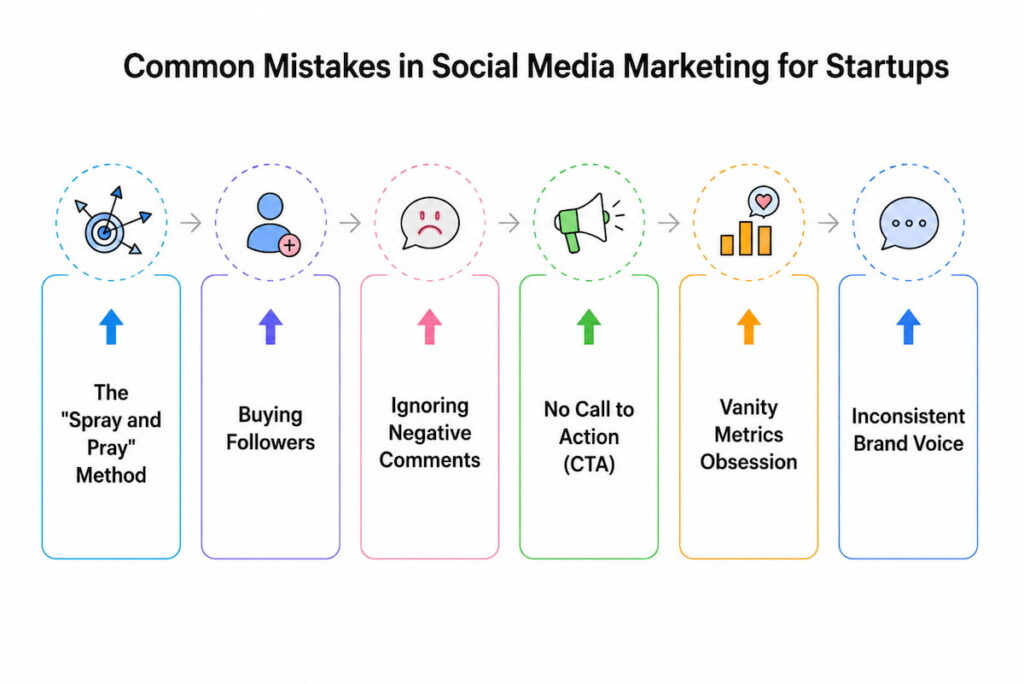
1. The “Spray and Pray” Method
Don’t copy and paste the same post everywhere. LinkedIn, Instagram, and TikTok are different. Instagram wants visuals. LinkedIn wants text. If you don’t adjust your format, your engagement will drop.
Simple fix: tailor your captions and images for each platform.
2. Buying Followers
It destroys your engagement rate. A bot account never buys your product. Investors look at the engagement-to-follower ratio. 500 engaged followers are worth more than 50,000 ghosts.
3. Ignoring Negative Comments
Startups are fragile, but deleting criticism makes you look dishonest. If someone complains publicly, respond publicly: “Sorry to hear that. DM us so we can fix this.” It shows accountability.
4. No Call to Action (CTA)
You post a beautiful infographic… and then what? Users will scroll away. Always include a CTA: “Click the link in bio,” “Retweet for a chance to win,” or “Comment ‘STARTUP’ for the template.”
5. Vanity Metrics Obsession
Likes and follows do not pay rent. Startups often celebrate a viral post that generated zero leads. Measure what matters.
6. Inconsistent Brand Voice
Is the startup formal or funny? If you tweet jokes but reply to DMs like a robot, you confuse the audience. Document your brand voice (e.g., “Friendly expert” or “Sarcastic genius”) and stick to it.
What Metrics Matter in Social Media Marketing for Startups
Most startups burn time on vanity metrics like total views. With social media marketing for startups, we need to focus more on what people do after they see your content — the actions that actually lead to revenue and loyal customers.
Start with awareness metrics: reach, follower growth rate (relative growth beats flashy big numbers), and how often your brand gets mentioned compared to rivals.
Engagement comes next. A good rate usually lands between 1% and 5%. If yours is lower, it’s often a sign your content needs improvement. Don’t forget to track shares and link clicks too.
Still, the real proof shows up at conversion. Measure how many clicks turn into sign-ups or purchases, your cost per lead, overall customer acquisition cost, and return on ad spend.
These numbers tell you if social is genuinely moving the needle. For the best view, combine native platform data with UTM tracking in Google Analytics 4.
Tools for Social Media Marketing for Startups
Startups don’t have money to burn. So don’t go buying expensive enterprise tools until there’s actual revenue coming in. Instead, go with what’s called the “Freemium stack.” It’s lightweight, it works, and most of it’s free.
Start with scheduling and publishing.
- Buffer – clean, cheap, solid for up to three platforms;
- Later – best if you’re heavy on Instagram visual planning;
- Hootsuite (free tier) – limited, but it gets the job done.
For content creation, use free tools that feel like magic. Canva is a total hero for startups. Thousands of templates for social graphics. CapCut? Better than most paid video editors, especially for TikTok and Reels. And then there’s ChatGPT or Claude – great for drafting captions, repurposing transcripts, or just brainstorming hooks when you’re stuck.
What about analytics? You don’t need much. Google Data Studio (now Looker Studio) lets you build a free dashboard. Brand24 has a freemium plan for social listening. But here’s the truth: Instagram and LinkedIn’s native insights are usually enough for the first six months.
Also, don’t forget link-in-bio tools. Linktree is free and essential for Instagram. Or try Biolink by Buffer – less bloated.
Conclusion
Social media marketing for startups is not about going viral. It is about building a reliable, repeatable system to connect with the people who need your solution. You do not need a big budget or a massive team. You need clarity: clear goals, clear customer understanding, and a clear voice.
Start small. Pick two platforms. Post three times a week. Engage for 15 minutes daily. Review your metrics on Monday morning. Adjust. Repeat. In three months, you will have an asset that scales with your company—and that is infinitely more valuable than a flash-in-the-pan viral moment.