For a long time, manufacturing companies knew exactly how to grow. You went to the big trade fairs, kept up your old relationships, and bought space in the right trade magazines. Nothing wrong with any of that.
Yet something big has changed. The deals that matter don’t only get made under the fluorescent lights of the shop floor anymore. Plenty of them are now happening on LinkedIn, in Instagram DMs, or while someone watches a quick video on YouTube.
So if your organisation has been slow to get serious about digital channels, you’re missing pieces that could actually move the needle. Social media marketing for manufacturing companies has moved way past the experimental stage. It’s simply part of doing business now.
You can show the precision that goes into your products, pull in talented people who are looking for their next role, start building trust with customers before they ever pick up the phone, and give your brand a human feel that spreadsheets and catalogues never could.
In this guide, we will walk you through the essential steps to build a robust social media marketing strategy, from setting goals to measuring ROI.
Why Social Media Marketing for Manufacturing Companies is Essential
Manufacturing still depends on relationships. People want to see who makes their parts, look inside the facility, and feel they can rely on you. This is especially true for businesses offering 3D printing in Sacramento CA, where showcasing real projects, production capabilities, and the people behind the work can help build trust before a customer ever reaches out.
It builds credibility quickly. Post real proof — ISO plaques, organised floors, proper quality checks — and prospects believe in you more.
It helps solve the talent problem, too. Instagram and TikTok let you show robotics, modern tech, and clean spaces instead of the old factory image.
And it supports your SEO without extra effort. Regular content brings traffic and helps your team get known for CNC or injection moulding expertise.
How to Set Goals for Social Media Marketing for Manufacturing Companies
It’s important to define success before you begin posting. In manufacturing, social media goals are rarely the same as those used by B2C companies. You’re usually not looking for millions of views. What matters most is bringing in qualified leads and finding skilled workers.
Using the SMART framework helps keep your objectives focused and realistic. Common goals include:
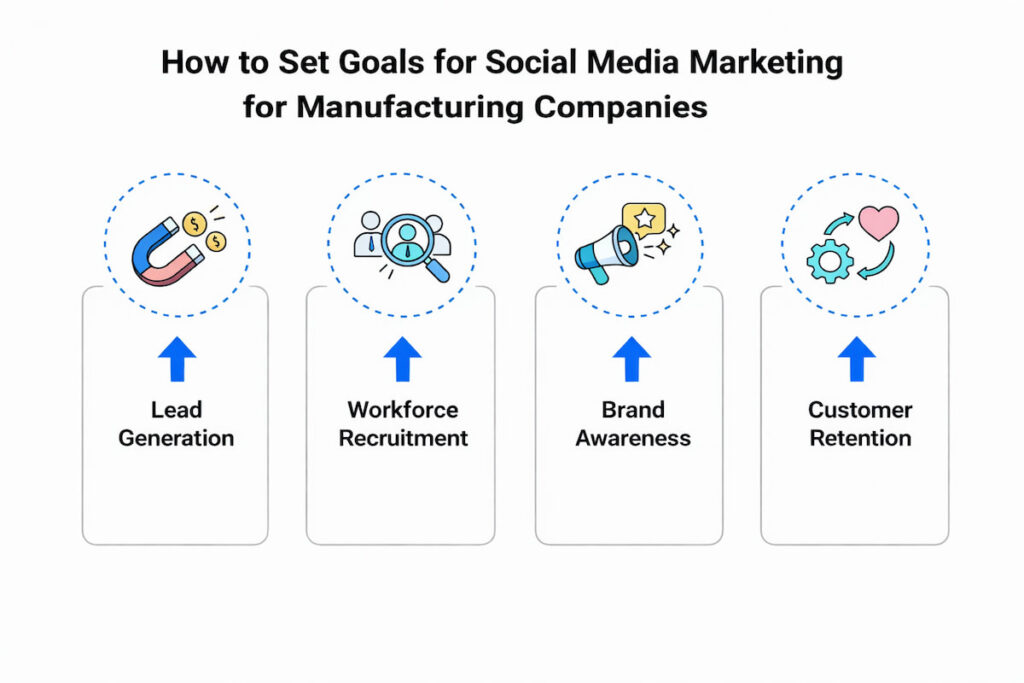
- Lead Generation: Drive more people to fill out your “Request a Quote” form;
- Workforce Recruitment: Cut your cost-per-hire by recruiting candidates on LinkedIn or Facebook Jobs;
- Brand Awareness: Build a stronger presence in your specific field, whether aerospace, medical devices, or another sector;
- Customer Retention: Create a private Facebook Group so existing clients can easily get technical help and product news.
With well-defined goals, your social media activity stays connected to real business outcomes instead of just vanity metrics.
How to Choose the Right Platforms for Social Media Marketing for Manufacturing Companies
Manufacturers don’t need to be everywhere online. Spreading yourself across too many platforms usually wastes time and budget.
It’s smarter to concentrate on the networks your customers and talent actually use.
LinkedIn is still the most important one for B2B manufacturing. You’ll find procurement officers, engineers, and decision-makers there. It’s ideal for sharing technical content, case studies, and thought leadership pieces.
Once you know who those decision-makers are, AI sales prospecting tools including LinkedIn Sales Navigator and dedicated B2B data platforms, can help your team find and reach them faster.
YouTube acts as your visual portfolio. Short facility tours, machine operation videos, and production process clips work especially well. They also become evergreen material your sales team can keep using.
Instagram and Facebook are great for attracting talent and building community.
When optimizing campaigns for mobile-first audiences, mobile proxies can help teams test how social content and landing pages appear through mobile carrier networks in different regions.
Use Instagram for culture, employee spotlights, and product photos. Facebook helps with local engagement and hiring.
Twitter (X) can help with industry news and quick updates, but it generally delivers lower results for most industrial companies.
Content Strategy in Social Media Marketing for Manufacturing Companies
The content you post needs to serve two audiences. Engineers want to see the technical details. Buyers want to know they can trust you. The smart approach is to mix things up—some educational posts, some behind-the-scenes shots, and some proof from real clients.
1. Behind-the-Scenes (The Human Element)
Start with behind-the-scenes content. People like to see where their parts actually come from. Show your CNC machines running, walk through the quality lab, or introduce the technicians who keep everything precise.
These posts add a human side to the brand and help build the kind of trust that’s often missing in industrial deals.
2. Educational Content
Next, focus on educational content. This is where you position your company as the go-to expert.
Short videos explaining why you choose one material over another or how a particular finishing process works perform really well. Simple infographics that break down your quality control steps can also demonstrate reliability more effectively than any traditional brochure.
3. Customer Testimonials and Case Studies
Don’t forget customer stories. When you’ve helped a client cut lead times by 30%, share it. A short video testimonial or a detailed post (with the client’s permission) makes a strong impact. On LinkedIn, carousel posts that lay out a full case study tend to get solid engagement.
4. Facility Tours and Safety Protocols
And keep showing the factory. Clean, safe, well-run. These days, buyers really notice that. They want to see that their supply chain won’t fall apart the moment things get tough.
Common Mistakes in Social Media Marketing for Manufacturing Companies
Here are the mistakes manufacturers make most often.
Treating Social Media as a Bulletin Board
Broadcasting press releases and sales pitches isn’t enough. You have to engage. Reply to comments. Interact with peers. Share partner content. Otherwise, the algorithm stops showing your posts.
Focusing on Products Instead of Solutions
A post showing a pile of metal parts is boring. A post showing how those metal parts solved a heat dissipation issue for an automotive client is compelling. Shift your focus from what you sell to why it matters.
Ignoring Video
In manufacturing, video is non-negotiable. Static images of machinery rarely convey the scale or sophistication of your operations. Short-form video (Reels, Shorts, TikToks) is currently the highest-return format for social media marketing for manufacturing companies. If you aren’t filming your shop floor, you are invisible to the algorithm.
Inconsistent Posting
Manufacturers often post furiously for two weeks, get no sales, and give up. Social media is a long-term asset. Consistency over months is what builds the trust necessary for a high-ticket B2B sale.
What Metrics Matter in Social Media Marketing for Manufacturing Companies
Tracking real ROI from social media isn’t always straightforward. Especially when your sales cycles stretch out for months. Once you know exactly what you’re trying to achieve, though, the important numbers become much clearer to watch.
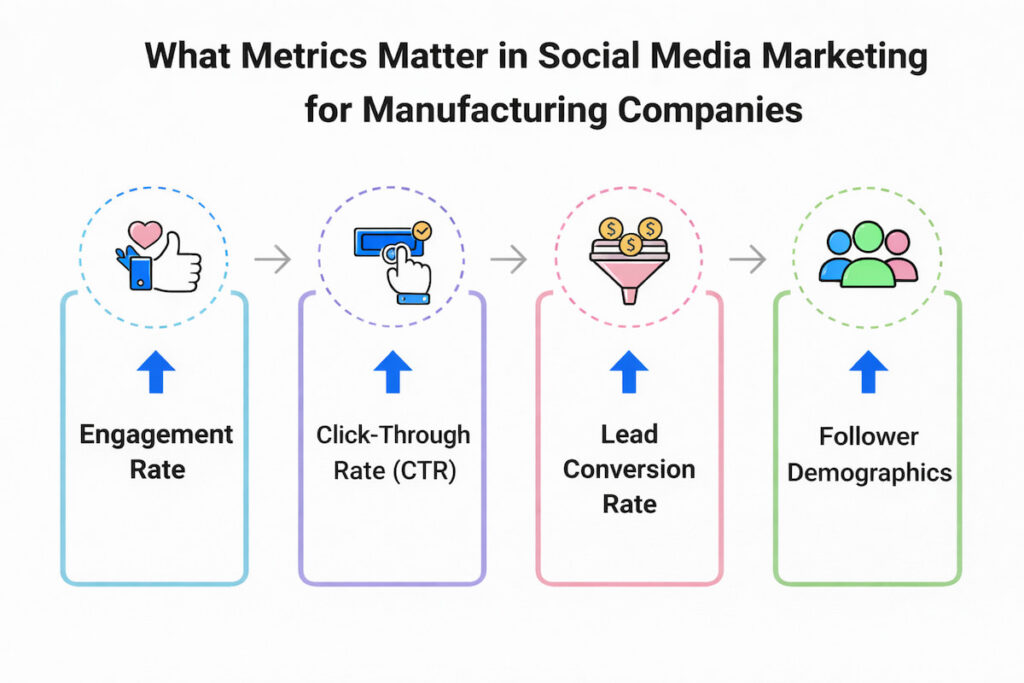
- Engagement Rate. Ignore likes. Focus on shares and savings. When someone sends your post to a colleague, that means your content has actually connected;
- Click-Through Rate (CTR). How many people clicked your link? That tells you whether your call-to-action is working or falling flat;
- Lead Conversion Rate. This is the metric that counts. How many interactions turned into form fills, demo requests, or phone calls? Use UTM parameters to track which platform delivers the real leads;
- Follower Demographics. Look at who’s following you. If your audience is mostly competitors instead of procurement managers, you need to adjust your content.
Tools for Social Media Marketing for Manufacturing Companies
Most manufacturers don’t have a dedicated social media person. You’re juggling marketing with actual production work. So efficiency matters. The right social media marketing tools help you get more done in less time.
Scheduling Tools
Hootsuite, Buffer, Sprout Social. Pick one. Batch your content once a month, schedule it out, and move on. You can’t stop posting every day, so this is non-negotiable.
Graphic Design
Canva. Templates are already sized for LinkedIn and Instagram. You take technical specs and turn them into simple visuals. Infographics. Process diagrams. No designer needed.
Video Editing
CapCut or Adobe Premiere Rush. Both are easy to learn. You shoot shop floor footage, edit it down, and get short videos that look decent without a steep learning curve.
Analytics
Native tools like LinkedIn Analytics and Meta Business Suite give you basic numbers. But Google Analytics tells you what actually matters—whether people clicked through and requested a quote.
Conclusion
Manufacturing runs on precision, quality, and trust. Social media marketing for manufacturing companies is just a way to show those values to the people who matter.
Pick one platform to start—LinkedIn is usually the smart choice. Post video content twice a week. Real shop floor footage works fine. And when people comment, actually respond.
Don’t let your feed become a constant sales pitch. Stick with educational content or behind-the-scenes looks. Set clear goals and be consistent. Consistency builds credibility, and credibility sets you apart.