These days, word-of-mouth happens mostly online. If you run a local store, restaurant, service company, or professional practice, having a solid social media presence isn’t a nice-to-have anymore — it’s necessary.
A presence only works when the creative is good, and Bonus Track gives local brands content that earns attention instead of getting scrolled past.
Big national brands battle for attention across the whole country. But local companies have something they don’t: the ability to connect directly with people in the community. That’s why social media marketing for local businesses has become an important part of attracting customers and building trust.
The catch? Without a proper plan, random posting just burns time and money.
In this guide, you’ll get a clear roadmap for doing social media right — starting with goals and going all the way through to measuring your results.
Why Social Media Marketing for Local Business is Essential
Many local business owners ask, “My customers find me through Google or word-of-mouth. Why do I need social media?” The answer lies in consumer behavior. Over 70% of people say they are more likely to use a local business if they have an active, engaging social presence.
Here’s why social media marketing for local business is critical today:
- Discovery: Before visiting a new spot, people check social media. Your profile is their first look—so make it count;
- Trust: Regular posts and replies build credibility. A stale page just screams neglect;
- Local targeting: Target a 1–5 mile radius on Facebook or Instagram. Reach people who live or work nearby;
- Foot traffic: One well-timed post about a special can drive real visits, not just likes;
- Cost: Social ads cost pennies per impression. That’s unbeatable compared to print or TV.
Ignoring social media means leaving the front door of your online presence locked.
How to Set Goals for Social Media Marketing for Local Business
Don’t make a single post before you define what winning looks like.
Goals for social media marketing for local business need to be SMART. Specific. Measurable. Achievable. Relevant. Time-bound. And please—avoid vanity metrics like “more likes.” Those don’t pay rent.
Instead, focus on real business outcomes:
- Want more foot traffic? *”Drive 50 extra in-store visits per month from social media.”*
- Need local awareness? “Reach 5,000 unique local users within ten miles over 60 days.”
- Chasing leads or appointments? “Get 20 service inquiries from Facebook each month.”
- Promoting an event or sale? “Sell 40 workshop tickets or 15 units of a new product via Instagram.”
How do you track this? Use UTM parameters on your links. Offer in-store codes like “Show this post for 10% off.” Or just ask new customers directly: “How did you find us?”
Without clear goals, social media marketing for local businesses becomes random noise. Not a strategy.
How to Choose the Right Platforms for Social Media Marketing for Local Business
The real secret? Don’t spread yourself too thin. Show up where your local customers already spend time.
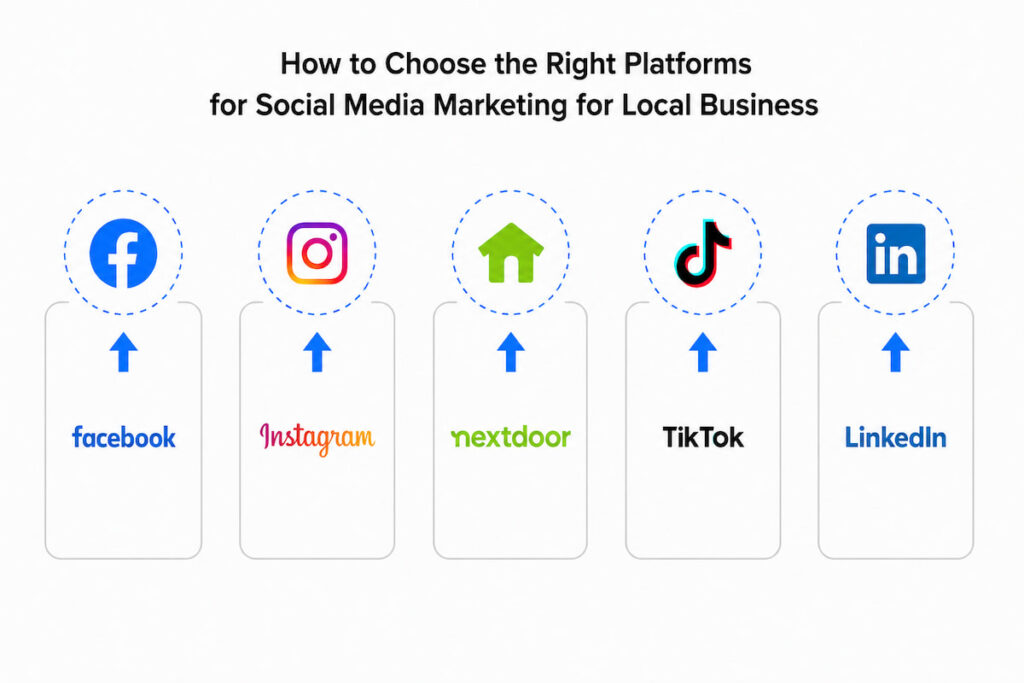
Facebook is usually the strongest starting point. It handles events, updates, and local ads very well. Restaurants, shops, home services, and clinics tend to perform best here.
Instagram is ideal when images and videos are central to your brand. Use it for product shots, before-and-afters, and day-to-day content. Tools such as an instagram story viewer can also help businesses understand how Instagram Stories are being viewed and used by audiences. Salons, boutiques, bakeries, and studios often see the most success.
Other platforms worth checking:
- Nextdoor: The most neighborhood-specific network. Answer local questions and use Nearby Ads. Great for contractors, real estate, pet services, and repairs;
- TikTok: Short, genuine videos can go viral locally. Works surprisingly well for cafes, food spots, bookstores, and specialty shops;
- LinkedIn: Only relevant for B2B services like accounting, IT support, or commercial printing. Most local businesses can ignore it.
Content Strategy in Social Media Marketing for Local Business
Content powers social media for local businesses, but it doesn’t need to be perfect or expensive. Local people prefer authentic posts.
Use the 80/20 rule: 80% valuable or engaging content, 20% promotional.
Effective content ideas:
- Behind-the-scenes of your team and daily work;
- Collaborations with nearby businesses;
- Customer photos and stories (with permission);
- Reposting reviews and user content;
- Community events and sponsorships;
- Helpful tips and how-to posts;
- Time-sensitive special offers;
- Polls and simple questions;
- Local news or weather tie-ins;
- Employee takeovers.
Post consistently, around 4–5 times per week. A content calendar makes it much easier to stay on track with seasons and local happenings.
Common Mistakes in Social Media Marketing for Local Business
A lot of local owners mess this up, even when they have good intentions. So let’s go through the common mistakes in social media marketing for local business.
No visual identity. Blurry photos. Random colors. No logo. That screams unprofessional. Use natural lighting and a free tool like Canva.
Ignoring comments and DMs. A customer asks a question. You reply four days later. That tells them you don’t care. Respond within a few hours when possible.
Too salesy. “Buy now!” in every post? Annoying. Remember: educate, entertain, then sell sparingly.
Copy-paste across platforms. What works on LinkedIn looks ridiculous on TikTok. Tailor your content.
Not mobile-friendly. Ninety percent of local social browsing happens on phones. Use vertical images (9:16 ratio) and large, readable text.
Forgetting local hashtags. #LoveNYC or #AustinEats can work. Avoid overused global tags like #Love. Use your city or neighborhood name.
No call-to-action. Every post should gently guide the viewer. “Tap for hours.” “Call to book.” “Click for map.”
What Metrics Matter in Social Media Marketing for Local Business
Improving your local social media marketing means tracking the right metrics — not just likes. Most are available straight in Facebook/Instagram insights.
Focus on these:
- Local Reach: How many nearby people actually see your content;
- Engagement Rate: Do locals like, comment, and share?;
- Clicks & Calls: How many visit your site or call you?;
- DMs: Incoming messages asking questions or booking;
- Check-ins & Tags: Customer mentions and location tags;
- Foot Traffic: Ask new customers how they found you;
- Ad Conversions: How many bookings or leads from paid ads.
Check these once a week. Low engagement with high reach? Fix your content. Good engagement but no sales? Strengthen your calls-to-action.
Tools for Social Media Marketing for Local Business
You don’t need a big budget. These tools save hours every week:
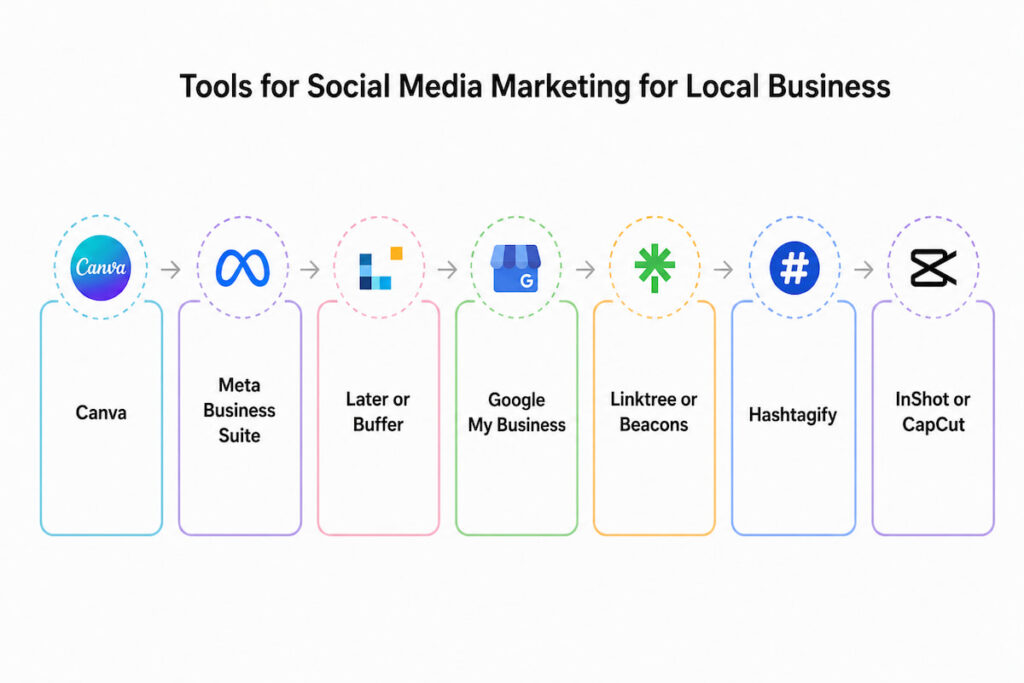
Canva (Free / Pro). Creates stunning posts, flyers, and Instagram stories. Essential if you’re not a designer.
Design.com (Free / Pro). A useful option for creating simple, professional-looking graphics for social media. Its logo design tools can also help you create branded visuals that keep your local business content consistent across different platforms.
Meta Business Suite (Free). Schedule posts to Facebook and Instagram. See insights. Manage messages from one place.
Later or Buffer (Free tier available). Schedule visual content. Great for planning a monthly calendar.
Google My Business (Free). Not exactly social media, but it works alongside it. Post photos, updates, and Q&A.
Linktree or Beacons (Free). One “link in bio” that leads to your menu, booking page, and current offers.
Hashtagify (Free basic). Finds the best local hashtags for your city and niche.
InShot or CapCut (Free). Edit vertical videos for Reels or TikTok. Add text and music easily.
Start with just Canva and Meta Business Suite. Add the rest as you grow.
Conclusion
Ready to launch or fix your social media marketing for local business? Here’s a simple 30-day plan.
Week 1: Set two or three SMART goals. Claim or optimize your profiles. Get the profile photo, bio, hours, and map link right. Install Meta Business Suite.
Week 2: Brainstorm ten content ideas from the list above. Shoot five short vertical videos and ten photos. Design reusable templates in Canva.
Week 3: Post every other day. Engage daily—respond to every comment and DM. Run a small local awareness ad. Twenty to fifty dollars, targeted within two miles.
Week 4: Look at your metrics. Which post got the most local reach? Which CTA drove the most clicks? Double down on what actually worked.
Here’s the beauty of social media marketing for local business. You can start today, for free, with just a smartphone and a willingness to connect. Your neighbors are already scrolling. Make sure they find a warm, active, helpful local business when they land on your page.
That’s your real competitive advantage.